Source check: 9 September 2026. Announcement date: 1 September 2026. This report describes Axis Bank's published feature announcement; it is not a hands-on test of availability.
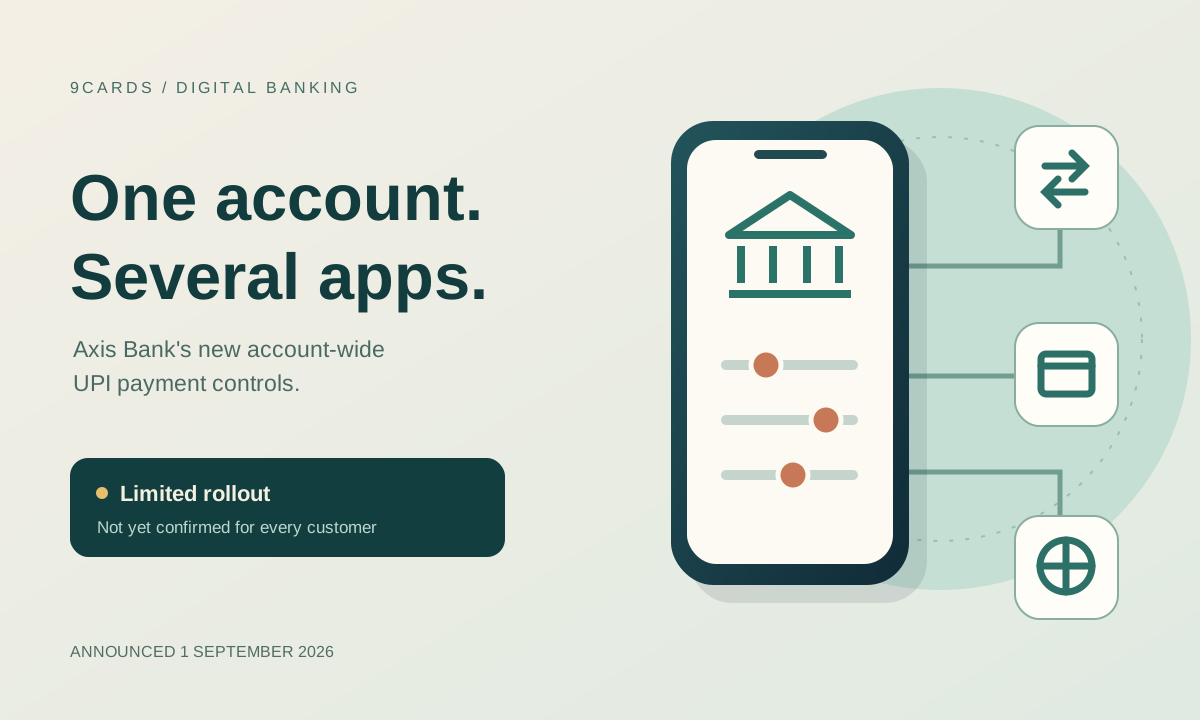
Axis Bank has announced UPI controls that are intended to work at the bank-account level, rather than only inside the app in which a payment is initiated. A limit configured in the bank's mobile app is described as applying across all UPI applications linked to that Axis Bank account.
That is the substantive change. A person may use one app to pay a shop and another to send money to a friend. If both draw on the same Axis account, the bank says its new controls can govern the account across those apps. This is not a new nationwide UPI ceiling, and it is not a control over accounts held with other banks.
There is an equally important qualification: the release says the feature has reached a limited set of customers. It promises wider availability but supplies no completion date. A customer who cannot see it in the app should not assume that their installation is faulty or that another person's screenshot proves universal availability.
What can be controlled
Axis separates the announced UPI controls into three payment categories:
| Category | What the announcement says | What it does not establish |
|---|---|---|
| Person-to-person payments | Customers can set a personalised transaction limit | A new national limit for sending money to individuals |
| Domestic merchant payments | A separate personalised limit can be configured | That the customer's chosen limit overrides other applicable bank or network limits |
| International merchant payments | A separate control is offered | Universal overseas merchant acceptance or availability for every customer |
This separation matters because different payment types can have very different purposes. A household may want a smaller limit for transfers to individuals while retaining more room for a planned merchant purchase. The release describes that control mechanism, but it does not prescribe a suitable amount for any particular customer.
It also does not specify the numerical minimum or maximum, a reset interval, a cooling period, or a complete eligibility list. We therefore do not describe these as daily limits or publish an invented set of recommended settings.
Where Axis says to find the feature
The bank's published navigation is Quick Links > Safety Centre > UPI Module, under Control Centre. Customers can view and modify the existing limits there.
Axis says changes require MPIN and OTP verification, followed by confirmation through in-app notifications and SMS. Those are statements about the feature's announced authentication flow, not a request to give credentials to anybody offering help. Enter credentials only in the bank's genuine application and never share a verification code with a caller.
Because the rollout is limited, app screens and eligibility may not yet match the announcement for every account. The sensible distinction is between a feature the bank has announced and a feature a particular customer can already use. This report verifies the former, not the latter.
Why account-level scope matters
An app-specific control and an account-level control are not interchangeable. An app-specific setting may describe only transactions initiated in that application. Axis's announcement instead says the settings apply across UPI apps linked to the relevant bank account.
That can reduce the need to repeat the same configuration in several places. It does not eliminate every other source of payment failure. An account can still be subject to other applicable restrictions, insufficient funds, risk checks or a service interruption. Nor does this announcement establish that a transaction already completed can be reversed by lowering a limit afterward.
Customers should also distinguish payment limits from card reward rules. Using UPI does not automatically make a transaction reward-eligible on a linked credit card. Our RuPay credit-card-on-UPI guide explains why the payment route and the issuer's reward treatment are separate questions.
A separate feature for overseas card use
The same release announces an International Travel Declaration for eligible credit-card customers. Axis gives the navigation as Credit Card > Control Center > International Travel.
The bank says advance travel information gives its fraud systems context and can reduce avoidable overseas declines. It does not promise that every foreign payment will be approved. A travel declaration is also not evidence of zero forex fees, unrestricted international usage or exemption from fraud checks.
Keeping the two announcements separate prevents a confusing conclusion: the UPI feature governs personalised payment limits, while the travel declaration informs credit-card risk assessment. They serve related safety goals but are not the same switch.
What remains to be confirmed
The release does not state a feature fee, but silence is not a verified permanent zero-fee commitment. Wider rollout timing, numerical limits and account-by-account eligibility are also unresolved in the material reviewed.
For now, this is a specific and useful banking development with a limited availability claim. It should not be repackaged as a rule imposed on all Indian UPI users.
Primary source
- Axis Bank: customer controls for digital banking, 1 September 2026. The account-wide scope, authentication steps, navigation and limited-rollout qualification come from this announcement.