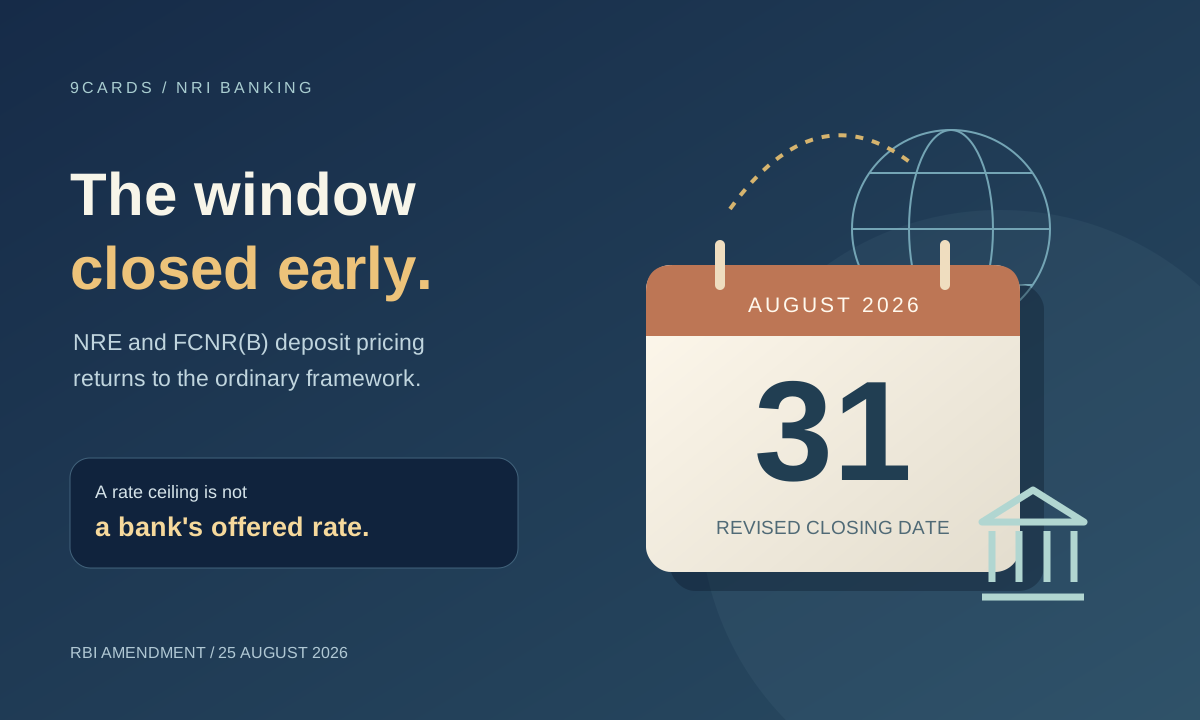
Source check: 9 September 2026. RBI amendment issued: 25 August 2026. Revised closing date: 31 August 2026. This article covers the commercial-bank directions linked below.
An NRI comparing deposit offers in September needs to check a date that changed in late August. RBI shortened the exceptional NRI deposit-rate relaxation from 30 September 2026 to 31 August 2026, bringing its closing date forward by one month.
The amendment is dated 25 August 2026 and came into force immediately. The temporary relaxation had begun on 17 June 2026. An older bank communication describing a September closing date can therefore be out of date even if it accurately described the rules when it was issued.
This is a change to a regulatory pricing window, not an announcement that every bank reduced every NRI deposit rate by the same amount. RBI's document does not publish a universal September customer rate.
Which deposits were covered
The temporary exemptions were narrower than the phrase "NRI deposits" might suggest:
| Deposit category | Deposits covered by the temporary exception | Position after the window closed |
|---|---|---|
| NRE | Fresh deposits and maturity renewals with tenors of three years and above | The normal comparison with rates on comparable domestic rupee term deposits applies |
| FCNR(B) | Fresh deposits and maturity renewals for three years through five years inclusive | The ordinary reference-rate-based ceiling applies |
| NRO-to-NRE transfers | Excluded from the specified NRE exception | The amendment does not create a new exemption for these transfers |
The normal commercial-bank rule says rates on NRE/NRO deposits must not exceed those on comparable domestic rupee term deposits. The temporary exemption concerned the specified NRE deposits; it was not a blanket removal of restrictions on every NRO account.
That distinction matters when deciding which document to read. An offer for a fresh qualifying NRE deposit, a transfer from NRO to NRE and a foreign-currency FCNR(B) deposit do not necessarily fall under the same pricing provision.
FCNR(B): a ceiling is not an offered rate
The consolidated directions set the ordinary FCNR(B) ceiling by reference to the relevant overnight alternative reference rate or swap rate. For deposits of three years through five years, the ceiling is that reference plus 350 basis points. For one year to less than three years, it is the reference plus 250 basis points.
A basis point is one-hundredth of a percentage point. These additions therefore describe margins of 3.50 and 2.50 percentage points above the relevant reference, not standalone interest rates of 3.50% and 2.50%.
RBI requires the relevant FBIL reference rates to be used. The actual customer rate must still be checked in the bank's rate schedule for the currency, tenor and placement date. A regulatory maximum does not oblige a bank to offer the maximum.
This also explains why a single headline such as "NRI FD rates cut to X%" would be unsupported by the amendment alone. Different currencies and tenors can have different applicable reference rates, and different banks can publish different offers within the framework.
What September depositors should compare
The most directly affected decisions are fresh placements and maturity renewals after the exceptional window. Before relying on a promotional rate, check whether the bank's current schedule still offers it for the relevant deposit category and date.
Keep the deposit currency, tenor, amount and renewal instruction consistent when comparing quotations. Changing several of those at once makes it difficult to tell whether a difference comes from this regulatory change or from a different product.
For a renewal, an earlier receipt describes the previous placement. It is not sufficient evidence of the terms of the next one. Ask for the bank's applicable renewal rate and conditions rather than assuming that either a promotional rate or an old maturity instruction guarantees the same return indefinitely.
What the amendment does not say
The amendment introduces no customer fee and specifies no uniform rate cut. It is not evidence that an existing fixed-rate deposit's contracted return has been retrospectively reduced. It also does not settle a particular customer's tax treatment, residency classification or premature-withdrawal costs.
Those questions need the deposit contract and the relevant bank or professional guidance. We have not checked individual banks' September rate cards for this article, so no institution is described here as offering the best current rate.
The practical news is precise: the exceptional window ended on 31 August. A decision made in September should be based on the ordinary rules and the bank's current offer, not on an expired timetable.
Primary sources
- RBI: Commercial Banks - Interest Rate on Deposits Third Amendment Directions, 25 August 2026, including the replacement of the 30 September date with 31 August.
- RBI: consolidated commercial-bank interest-rate-on-deposits directions, particularly paragraph 27(4) and its NRE exception, and paragraphs 32(7)-32(8) on FCNR(B) rates.