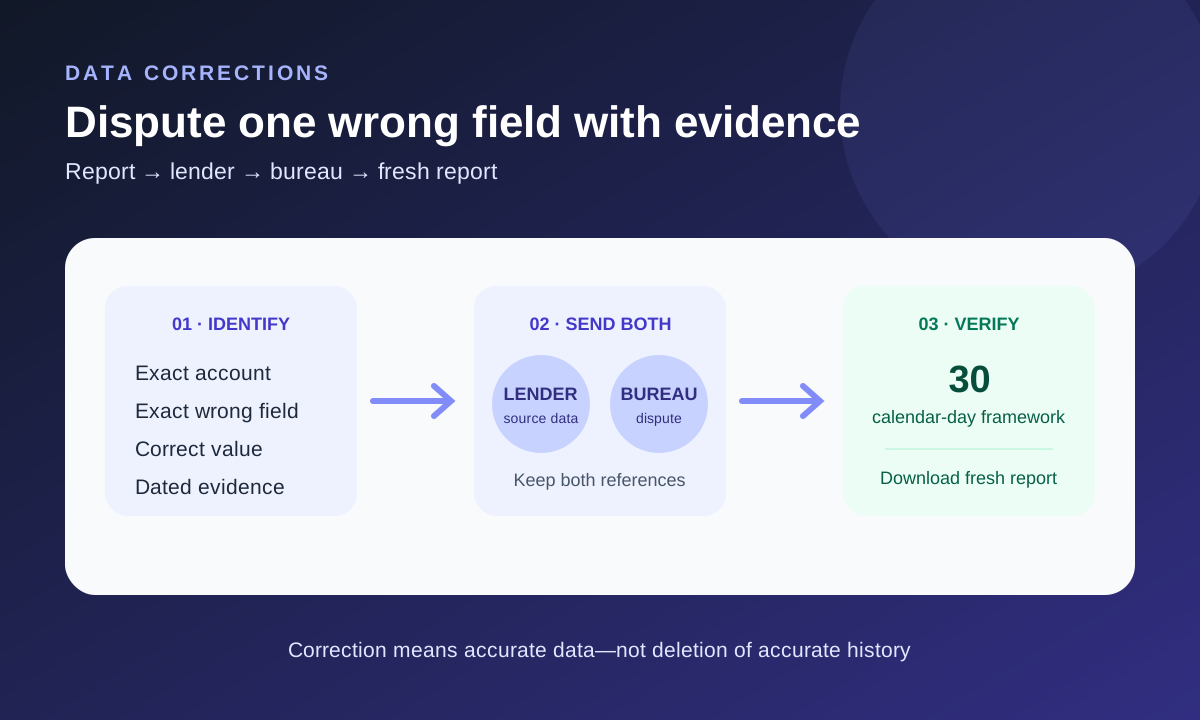
A credit report error is not “my score looks low”. It is a specific field that does not match the underlying account facts: an account you never opened, a payment incorrectly marked late, a balance that was not updated, wrong ownership, a closed card shown open, or a lender enquiry you did not authorise.
The correction process works best when you identify the exact record and send evidence to both the credit information company (CIC) and the credit institution (CI)—the lender or card issuer that supplied the data.
Accurate negative information is not an error merely because it is inconvenient. A dispute is for verification and correction, not guaranteed deletion.
Preserve the report before doing anything else
Download the complete report from the bureau’s official site and record its report/control number and date. Do not use screenshots from an unknown “score improvement” app as your only evidence.
Create a field-level table:
| Report field | Currently shows | Evidence-based correction requested |
|---|---|---|
| Account ownership | Individual | “Not mine; request identity/application verification” |
| Current balance | ₹42,000 | ₹0 after payment credited on 12 June |
| Account status | Open | Closed on 3 May; closure letter attached |
| Days past due | 30 | 0; issuer statement shows full payment by due date |
| Enquiry | Issuer X, 7 July | Not recognised; request consent/application proof |
Do not send a vague request to “fix CIBIL”. One account can contain dozens of fields, and “score” is an output rather than lender-supplied account data.
Check whether it is timing rather than an error
Statements, payments and bureau updates do not occur in real time. Compare:
- issuer statement date;
- payment credit date;
- account closure date;
- bureau report date;
- issuer’s stated reporting cycle.
A report generated before the issuer’s next reporting submission may legitimately show an earlier balance. Ask when the institution submitted the updated data. If the expected cycle has passed, open a dispute.
Contact both parties with the same facts
CIBIL’s dispute-resolution guide explains that CIBIL routes disputed account information to the relevant credit institution for verification and updates the report after receiving confirmation. The bureau cannot independently change lender-supplied account fields without that verification.
Submit through official channels and keep both reference numbers:
- file the bureau dispute against the exact account and field;
- complain in writing to the reporting issuer/lender;
- attach redacted statements, payment proof, closure letter or identity complaint relevant to that field;
- state the correct value and the source evidence;
- ask the institution to send corrected data to every bureau to which it reported the error;
- record submission dates and responses.
Mask card/account numbers except where the authenticated form requires them. Never post PAN, Aadhaar, full reports or dispute credentials publicly.
Understand the 30-calendar-day framework
CIBIL’s official framework for compensation describes the RBI framework under which a complaint must be resolved within 30 calendar days from initial filing. It allocates up to 21 calendar days to the credit institution to send corrected information to the CIC and the remaining nine days to the CIC to resolve the complaint after receiving it.
The framework provides compensation of ₹100 per calendar day when a complaint is not resolved within 30 calendar days, with allocation between CI and CIC based on which party exceeded its allotted time. The official page also lists exclusions and the complaint/appeal route. Compensation is not automatic proof that the consumer’s requested correction is substantively right; it addresses delayed resolution under the framework.
Track the timeline:
| Event | Date |
|---|---|
| Initial dispute received | ___ |
| Lender complaint received | ___ |
| Lender response/correction sent | ___ |
| Bureau closure message | ___ |
| Fresh report downloaded | ___ |
| Calendar days elapsed | ___ |
Use the date the initial complaint was received, not the date you later remembered to follow up.
Verify the result in a fresh report
A ticket marked “resolved” can mean the lender verified the existing value, supplied a correction, or responded that more evidence is needed. Download a new report and compare the same fields.
Possible outcomes:
- corrected: the requested field now matches evidence;
- verified unchanged: institution says the original entry is accurate;
- partially corrected: status changed but balance/history remains wrong;
- suppressed/deleted: record removed after verification;
- not updated yet: response promises a future reporting cycle.
If unchanged, ask the reporting institution for its verification basis. Reply with new evidence only if you have it; repeatedly reopening an identical unsupported dispute does not strengthen it.
Unknown account or enquiry
Treat an account you never opened as an identity and account-security issue, not only a scoring issue. Contact the named lender through independently verified details and ask for the application channel, consent and KYC investigation. Secure relevant financial and identity accounts, preserve complaint references and consider the appropriate cybercrime/police reporting route for suspected identity misuse.
CIBIL provides an official enquiry-dispute path for an enquiry a consumer does not recognise. A genuine enquiry from your own application should not be disputed solely because the application was declined. Our pending or declined application checklist explains how to match enquiries to application references.
Closed card still shown open
First confirm that the issuer actually closed the card account rather than merely blocking the plastic card. Check for:
- residual fee, interest or tax;
- unbilled transaction or refund;
- active EMI or recurring mandate;
- closure confirmation with effective date;
- later no-dues confirmation.
Attach the closure confirmation to the field-level dispute. Do not assume cutting the card or disabling it in an app closes the credit facility.
Late-payment marker you believe is wrong
Provide the statement amount, due date, issuer-credit date and payment reference. A payment initiated on the due date but credited later may be treated differently from one credited by the deadline under the applicable terms. Ask the issuer to reconcile its ledger and explain the reported days-past-due value.
If a refund affected the amount due, use the refund-after-bill checklist to separate refund timing from payment obligation.
Frequently asked questions
Can CIBIL change my account without asking the lender?
For lender-reported account data, CIBIL seeks verification from the reporting credit institution. Send the complaint to both parties.
Will a dispute increase my score?
Only a correction to underlying data may affect the calculated score. Filing a dispute itself does not promise an increase.
Can accurate late payments be deleted on request?
A correction process is not a method to erase accurate history. Ask for deletion only when the record is unauthorised, duplicated or otherwise incorrect and you have evidence.
Is the resolution period 30 working days?
The cited framework says 30 calendar days from initial filing, subject to its terms and exclusions.
Is ₹100-per-day compensation always paid after day 30?
The framework defines eligibility, allocation and exclusions. Track the dates, request compensation through the official process and escalate if the response does not follow the framework.
Should I pay a company to guarantee deletion?
No legitimate intermediary can guarantee removal of accurate lender data. Use bureau and lender channels and be wary of requests for credentials or false documents.
The practical answer
Name the wrong field, preserve the dated report, supply source evidence to the bureau and reporting institution, and track both references from day one. After closure, inspect a fresh report rather than relying on a status email.
The objective is accurate, verifiable data. A precise dispute protects that objective better than a general request to improve a score.
CIBIL framework and dispute materials checked on 31 July 2026. Source material was paraphrased; official processes and regulatory timelines should be rechecked when filing.