An annual fee waiver looks simple: spend a stated amount and the next fee is waived. In practice, disputes arise from the measurement period, the meaning of “spend”, excluded transaction types, refunds, supplementary cards and the date on which a purchase posts.
The safest approach is to audit the waiver like a statement reconciliation. Do it before the membership year closes, not after the fee appears.
Find the exact fee and waiver wording
Use the issuer’s current Most Important Terms and Conditions (MITC), schedule of charges and product terms. Do not rely only on an old sales message or comparison page.
Record these fields:
| Term | What to copy into your worksheet |
|---|---|
| Annual/renewal fee | Amount before tax and when it is billed |
| Waiver threshold | Required eligible spend |
| Measurement window | Card membership year, calendar year or another stated period |
| Included cards | Primary only or primary plus add-on spending |
| Exclusions | Cash, fees, interest, rent, wallet loads, fuel, EMI or other stated items |
| Refund treatment | Whether refunded transactions are deducted |
| Posting rule | Transaction date or settlement/posting date |
| Notification | How and when waiver or reversal appears |
SBI Card’s fees and charges FAQ is a useful issuer-specific illustration: it distinguishes annual fees by card type and notes that fee-waiver conditions depend on product terms. It is not evidence for another issuer or product. Always use your own card’s current document.
RBI’s credit-card FAQ also emphasises clear disclosure of charges and the calculation of fees on the adjusted outstanding. A renewal fee dispute should therefore identify the contractual fee and waiver condition, not merely assert that spending was “high”.
Identify the membership-year boundary
Many cards measure from account opening or card anniversary, not January to December. Ask the issuer for the exact start and end dates if the statement or app does not show them.
A purchase made on the final day may settle after the window. A refund posted in the next period may still reverse spend from the earlier purchase, depending on terms. Do not leave a large shortfall to the final week.
Create one row per posted transaction and use the issuer’s dates:
| Item | Posted amount | Eligible? | Adjustment | Counted amount |
|---|---|---|---|---|
| Retail purchase | ₹18,000 | Yes | ₹0 | ₹18,000 |
| Rent payment | ₹25,000 | No under example terms | −₹25,000 | ₹0 |
| Refunded purchase | ₹8,000 | Initially yes | −₹8,000 | ₹0 |
| Card fee | ₹2,000 | No | −₹2,000 | ₹0 |
| Add-on purchase | ₹6,000 | Verify terms | ₹0 or −₹6,000 | ₹___ |
The labels above are examples, not universal exclusions.
Reconcile net eligible spend
Use:
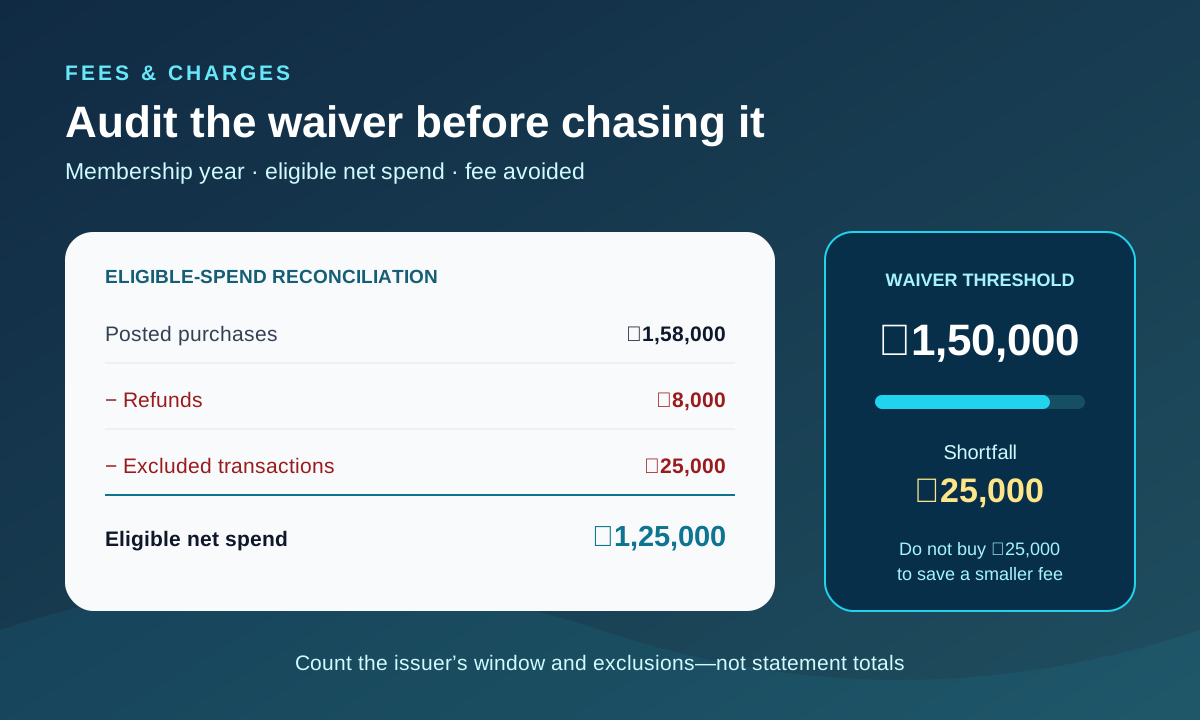
eligible waiver spend = included posted purchases − excluded items − refunds/reversals
Do not use the sum of statement totals. Statement totals can include earlier balances, finance charges, taxes, cash advances and fees. They can also omit unbilled purchases that later post within the window.
Keep a conservative buffer because late settlement, returns and issuer classification can change the total. But never manufacture spending merely to create the buffer.
Decide whether closing the gap is rational
Suppose the fee is ₹2,000 plus 18% GST, so avoiding it could save ₹2,360. You are ₹30,000 short of the threshold.
Spending ₹30,000 on planned purchases a little earlier may be reasonable if it creates no extra merchant fee and does not affect cash flow. Buying ₹30,000 of things you did not need to save ₹2,360 is a loss. Paying a 2% convenience fee and losing a better reward elsewhere also reduces the benefit.
Use a decision table:
| Question | If no |
|---|---|
| Was the purchase already planned? | Do not make it for the waiver |
| Will it count under current terms? | Do not assume it closes the gap |
| Is there no avoidable merchant/convenience fee? | Add that cost to the decision |
| Can you pay the full statement on time? | Do not chase the waiver |
| Is the saved fee greater than lost rewards/discounts elsewhere? | Use the better payment method |
Rewards should never be used to justify revolving debt. Finance charges can exceed the fee saved.
When the fee posts despite qualifying spend
First confirm whether the entry is a fee, a tax line, or a fee that will be reversed later. Then prepare a compact complaint:
- card product and last four digits only in the secure issuer channel;
- exact waiver period;
- published threshold and source document;
- your eligible-spend total with excluded items removed;
- relevant statement dates;
- fee and tax posting dates;
- action requested: calculation, waiver status or correction.
Ask the issuer to provide the transaction-level eligible-spend calculation. That is more useful than asking for a “manual waiver” before establishing whether the contractual threshold was met.
If the issuer confirms that a transaction type was excluded, request the clause applicable during your measurement period. Product terms can change, and a current page may not prove what applied earlier.
If the card is no longer worth its fee
A waiver is not the only outcome. Before the next renewal, you can consider:
- keeping the card and paying the fee because net benefits remain higher;
- requesting an available lower-fee product through the issuer;
- closing the card after redeeming rewards and clearing balances;
- keeping it only if a documented no-fee offer is confirmed in writing.
Do not threaten closure solely to obtain an unpromised retention benefit. Evaluate the card using the spend-led shortlist and value rewards with the redemption calculator.
Before closure, check unbilled transactions, EMIs, refunds, recurring mandates, reward forfeiture and credit-report update. Obtain written closure confirmation.
Frequently asked questions
Does paying the annual fee itself count towards waiver spend?
Usually charges and taxes are not treated as purchases, but only your issuer’s terms decide. Do not count the fee unless the waiver clause explicitly does.
Do EMI purchases count at the original amount?
Rules vary. Some programmes exclude EMI transactions; others may count the purchase or instalments under specified conditions. Check the waiver term, not the reward rule.
Does add-on card spending count?
It may aggregate to the primary account, but this is product-specific. Ask for written confirmation.
What if a qualifying purchase is refunded after the fee is waived?
The issuer may reverse eligibility or carry an adjustment according to its terms. Keep a buffer and retain the records.
Is a fee waiver the same as “lifetime free”?
No. A waiver is conditional on a threshold or offer period. A documented no-annual-fee arrangement has no recurring spend condition unless the written terms say otherwise.
Should I prepay the card to create extra limit and hit the threshold?
Prepayment does not make unnecessary spending sensible, and issuer rules may restrict credit balances or unusually high turnover. Use ordinary planned purchases within your limit.
The practical answer
Write down the exact window, threshold, eligible transaction definition and refund treatment. Reconcile posted net eligible spend with a buffer. If there is a shortfall, compare the true cost of closing it with the fee plus tax you would avoid.
A waiver is valuable only when normal, repayable spending earns it. Chasing a fee with unplanned purchases turns a benefit into a cost.
RBI and issuer materials checked on 31 July 2026. Source material was paraphrased; fee and waiver terms can change by product and period.