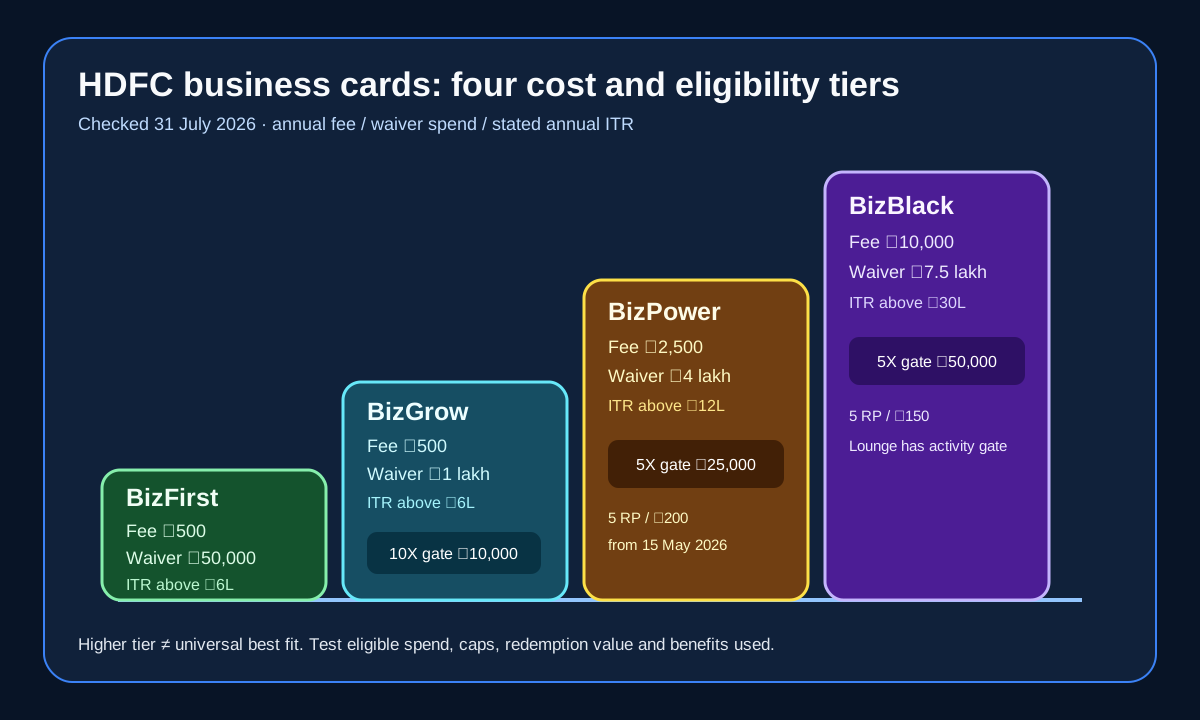
Choosing a credit card by its largest advertised number is a reliable way to choose the wrong card. A “10×” points headline says nothing by itself about the base earn rate, point value, eligible merchants, monthly cap, redemption fee or whether you can use the reward. “Four lounge visits” says little without a spend gate and airport list.
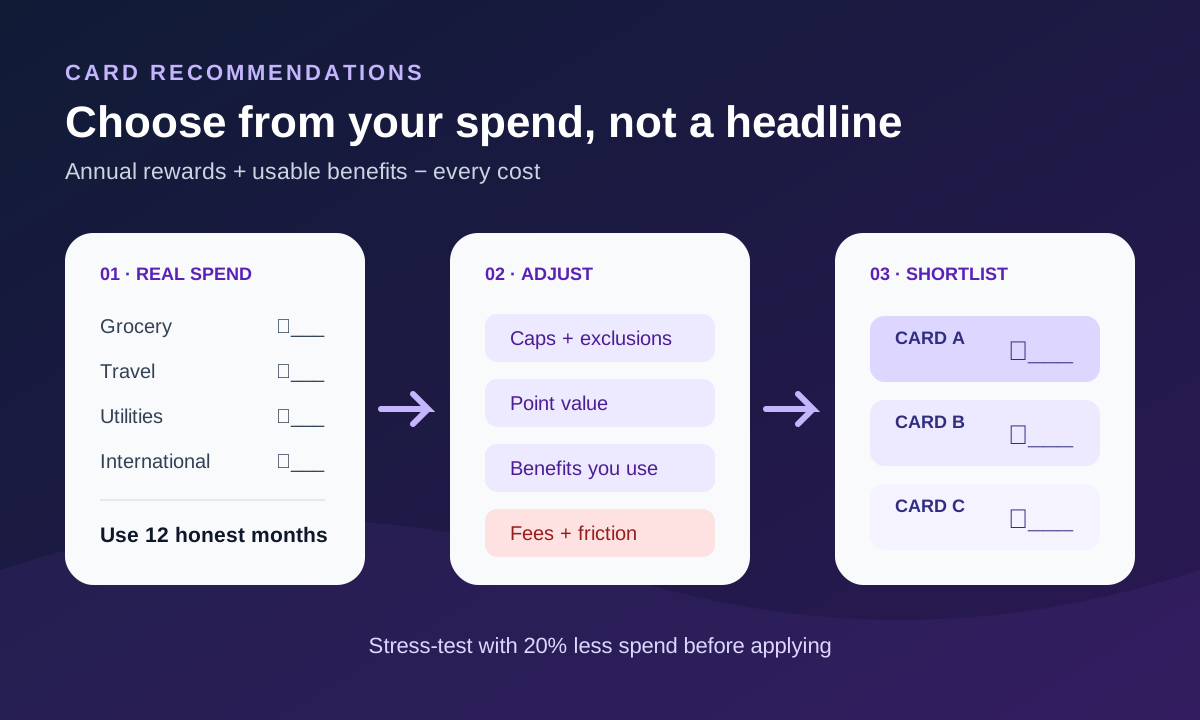
A neutral shortlist starts with your last twelve months of spending and ends with annual net value after costs. It does not start with a card name.
This framework is educational, not personalised financial advice or an approval prediction. It helps you compare published terms consistently.
Step 1: build a spending map
Use statements or a budget to estimate ordinary cardable spend. Keep categories that reward programmes commonly treat differently.
| Annual spend bucket | Your estimate | Why it needs its own row |
|---|---|---|
| General retail | ₹___ | Often earns the base rate |
| Grocery/dining | ₹___ | May receive a category bonus or cap |
| Travel | ₹___ | Can earn differently by booking channel |
| Utilities/insurance/education | ₹___ | Frequently subject to exclusions or reduced earn |
| Fuel | ₹___ | Reward and surcharge-waiver rules differ |
| Rent/wallet/government | ₹___ | Often excluded or fee-bearing |
| International | ₹___ | Forex markup can outweigh rewards |
| EMI purchases | ₹___ | May not earn or may reverse rewards on conversion |
Do not inflate future spending to justify a fee waiver. Use a conservative year and exclude purchases you would make only to trigger a benefit.
Step 2: convert every reward into rupees
A reward rate needs four inputs:
annual eligible spend × earning rate × usable value per point
If ₹1,20,000 earns 2 points per ₹100, it produces 2,400 points. If your realistic redemption gives ₹0.25 per point, the annual value is ₹600—not “2%” and not ₹2,400.
Point value can vary by redemption route. Statement credit, vouchers, catalogue items, travel portals and transfers can use different ratios and fees. SBI Card’s official redemption FAQ illustrates why the route matters: programme rules can impose redemption processes and limits that are separate from earning.
Our reward redemption-value calculator provides a full worked example.
Step 3: apply caps before comparing
A capped accelerated rate is two rates: the headline rate until the cap, then the fallback treatment.
| Published feature | Question to calculate |
|---|---|
| 5% cashback, ₹500 monthly cap | At what eligible spend does the cap run out? |
| 10× points on portal bookings | What is the monthly point cap and portal price difference? |
| Quarterly milestone | Is ordinary spending enough without prepaying or overspending? |
| Annual fee waiver | Which transactions count and what is the membership-year window? |
| Lounge spend gate | Which prior-period spend unlocks which future visits? |
Use our cashback-cap explainer to turn the cap into a maximum eligible-spend band. A high rate on only a small slice can lose to a lower uncapped rate.
Step 4: subtract unavoidable costs
Calculate costs for the way you will actually use the card:
- joining and annual fees plus applicable tax;
- reward redemption or transfer fees;
- portal price premium compared with booking direct;
- forex markup and tax on foreign transactions;
- add-on, replacement or cash fees you genuinely expect;
- opportunity cost of spending extra solely for a waiver or milestone.
Do not include late fees or revolving interest as a routine cost to offset with rewards. If you expect to carry a balance, reward optimisation is the wrong comparison: finance charges can overwhelm the benefit.
RBI’s current credit-card directions for commercial banks require important terms and charges to be disclosed. Use the issuer’s MITC and schedule of charges, not only the product landing page.
Step 5: value benefits conservatively
A benefit is worth the lower of its real price and what you would willingly have paid.
If a lounge visit is advertised as worth ₹1,500 but you would otherwise wait at the gate and spend ₹300, do not assign ₹1,500. If a hotel voucher requires a more expensive booking channel, subtract the difference. If you never use golf, concierge or dining memberships, their value is zero for your shortlist.
| Benefit | Conservative value rule |
|---|---|
| Lounge visit | What you would otherwise spend, only for visits you expect and qualify for |
| Voucher | Face value minus restrictions and price differences |
| Insurance | Zero unless cover, exclusions and claim process meet a need |
| Welcome gift | One-time value; do not treat as annual |
| Renewal benefit | Count only if fee payment and other conditions will be met |
| Merchant offer | Count only if recurring and not already available on another card |
Step 6: test acceptance and friction
The mathematically highest-value card can still be a poor fit if redemption is difficult or the payment route you use is excluded. Check:
- merchant acceptance where you spend;
- preferred network features such as supported UPI merchant payments;
- whether rewards require a specific portal;
- minimum redemption size and expiry;
- customer-service channels and statement clarity;
- whether the issuer offers transaction controls you need;
- number of cards you are willing to manage.
RBI’s network-choice rule creates choice for eligible customers of covered issuers, but it does not put every product on every network.
Build a three-card shortlist
Score no more than three candidates against the same sheet.
| Measure | Card A | Card B | Card C |
|---|---|---|---|
| Annual eligible rewards | ₹___ | ₹___ | ₹___ |
| Usable annual benefits | ₹___ | ₹___ | ₹___ |
| Annual fee + tax | ₹___ | ₹___ | ₹___ |
| Other expected costs | ₹___ | ₹___ | ₹___ |
| Estimated net value | ₹___ | ₹___ | ₹___ |
| Complexity/risk note | ___ | ___ | ___ |
Then run a downside case: spend 20% less, miss one milestone and redeem at the lower-value route. A card that remains useful in the downside case is often a more robust fit than one requiring perfect behaviour.
Approval is a separate decision
Published income thresholds or invitation labels do not guarantee approval. Issuers consider their own underwriting policy, existing exposure, identity and income verification, credit history and other information. Multiple applications can also create multiple enquiries.
Do not apply to every candidate simultaneously just because the spreadsheet is close. Choose the strongest fit, verify current terms and submit accurate information. If declined, use the application-status checklist before applying again.
Frequently asked questions
Should I choose lifetime-free over a paid card?
Not automatically. Compare verified net annual value and the durability of the no-fee status. A paid card can be better if usable benefits exceed the fee; a free card can be better if it avoids effort and unused perks.
How many cards should I shortlist?
Three is enough for a disciplined comparison. More candidates usually produce duplicated features and stale terms rather than a better decision.
Should I count issuer offers in annual value?
Only if they are predictable and relevant. Limited merchant offers change frequently and should not carry the base case.
Is a higher reward rate always better?
No. Caps, exclusions, point value, redemption fees and eligible channels decide the realised rate.
Can a recommendation guarantee approval?
No. A recommendation evaluates fit; the issuer separately evaluates eligibility and risk.
How often should I redo the calculation?
Review after a material programme change, fee change or shift in spending—not every time a temporary offer appears.
The practical answer
Choose the card that produces the best conservative net result for spending you already do, with terms and redemption routes you can verify. Treat welcome offers as one-time, benefits as valuable only when used, and approval as a separate issuer decision.
A simple spreadsheet with honest inputs is more reliable than a ranking built around the largest percentage on a marketing page.
RBI and issuer materials checked on 31 July 2026. Source material was paraphrased; card pricing, rewards and eligibility can change.