A balance of 20,000 reward points can be worth ₹20,000, ₹5,000, a flight with limited availability, or nothing if the points expire before you use them. The point count alone is not a value. You need the conversion rule for a specific redemption route and the costs required to complete it.
The practical calculation is:
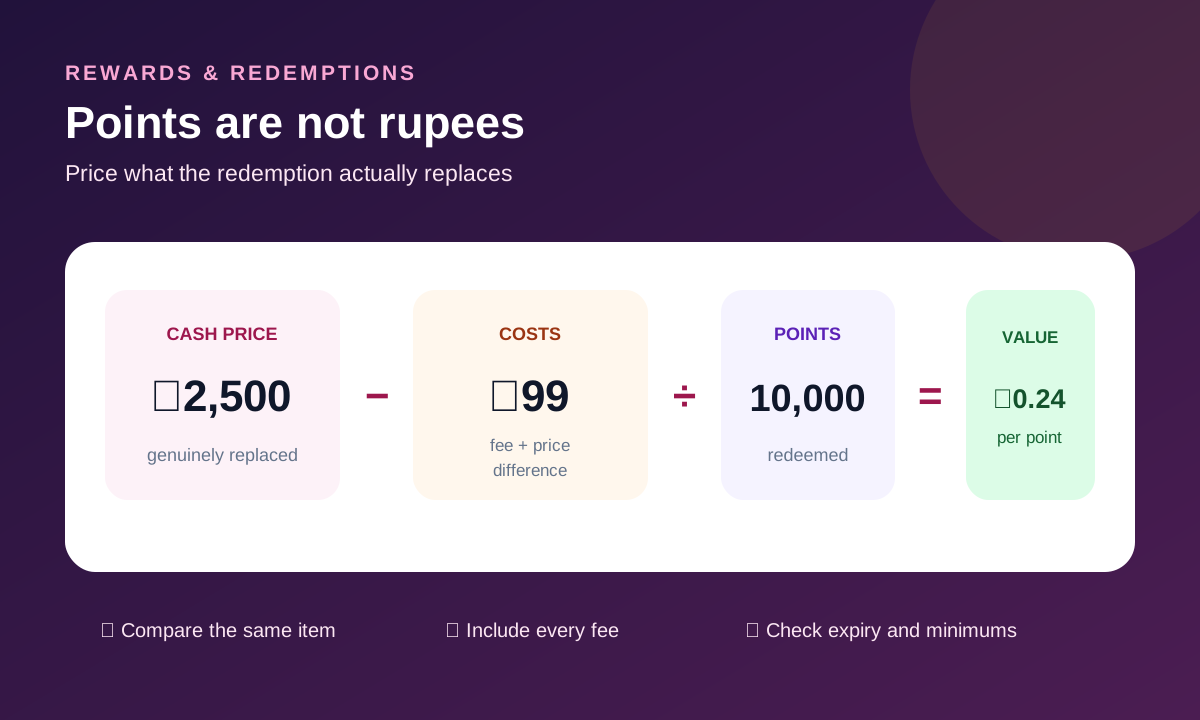
net redemption value = cash price genuinely replaced − redemption fee − taxes or surcharges − any portal price premium
Then divide that result by the points used:
value per point = net redemption value ÷ points redeemed
This method lets you compare statement credit, vouchers, merchandise, travel portals and transfer partners without treating a marketing label as cash.
Start with the route, not the advertised maximum
Issuer programmes frequently offer several routes with different conversion ratios. SBI Card’s official reward redemption FAQ, for example, describes redemption through its catalogue and a “Pay with Rewards” option. The existence of multiple routes is the reason to check the terms for the route you will actually use rather than applying one assumed point value to the whole balance.
Build a table from the issuer’s current programme page:
| Redemption route | Points required | Comparable cash price | Costs/difference | Net value per point |
|---|---|---|---|---|
| Statement credit | 10,000 | ₹2,500 | ₹99 fee | ₹0.2401 |
| Brand voucher | 8,000 | ₹2,000 | ₹0 | ₹0.25 |
| Travel booking | 12,000 | ₹4,200 | ₹300 higher portal price | ₹0.325 |
| Merchandise | 9,000 | ₹2,400 | ₹250 cheaper elsewhere | ₹0.2389 |
These figures are examples, not SBI Card conversion rates. Replace them with the live terms and the price available to you on the same date.
Compare like with like
A reward replaces only what you would otherwise buy. If a catalogue lists headphones at ₹4,000 but the same model is available from a reputable seller for ₹2,900, the comparable value is ₹2,900. If a travel portal ticket costs ₹8,500 while the airline sells the same fare and baggage bundle for ₹7,900, using points against the portal price does not create ₹8,500 of value.
Use the same:
- product model or hotel room type;
- travel date, fare class and baggage;
- cancellation and refund conditions;
- taxes, convenience fees and delivery charges;
- voucher restrictions and expiry.
Screenshots can help preserve a same-day comparison, but do not share account identifiers or reward balances publicly.
Calculate the realised reward rate
After finding point value, connect it back to the spend that earned the points:
realised reward rate = net redemption value ÷ eligible spend × 100
Suppose ₹1,00,000 of eligible spend earns 2,000 points. Redeeming those points at a net ₹0.25 each gives ₹500, or a 0.5% realised reward rate. If the earning rate was accelerated on only ₹20,000 and the remaining spend earned the base rate, calculate each bucket separately.
| Spend bucket | Spend | Points earned | Value per point | Net reward |
|---|---|---|---|---|
| Accelerated category | ₹20,000 | 1,200 | ₹0.25 | ₹300 |
| Base category | ₹70,000 | 700 | ₹0.25 | ₹175 |
| Excluded category | ₹10,000 | 0 | — | ₹0 |
| Total | ₹1,00,000 | 1,900 | — | ₹475 (0.475%) |
This exposes a common mistake: multiplying the highest advertised earn rate by all card spending.
Check minimums, caps and expiry
A theoretical value may be unreachable if the programme requires a minimum redemption larger than your likely balance. SBI Card’s earning FAQ says its reward points are valid for 24 months from accrual and are forfeited when the card is closed. That is an issuer-specific rule, not a universal 24-month standard; verify your own programme.
Record:
- expiry for each earning batch;
- minimum points per redemption;
- maximum points usable per booking or transaction;
- whether a redemption fee applies per request;
- whether points expire or transfer when a card is upgraded, downgraded or closed;
- processing time before a voucher or credit is available.
A small balance redeemed early at a modest rate can be better than waiting for an unreachable “best” route while points expire.
Treat transfers as conditional value
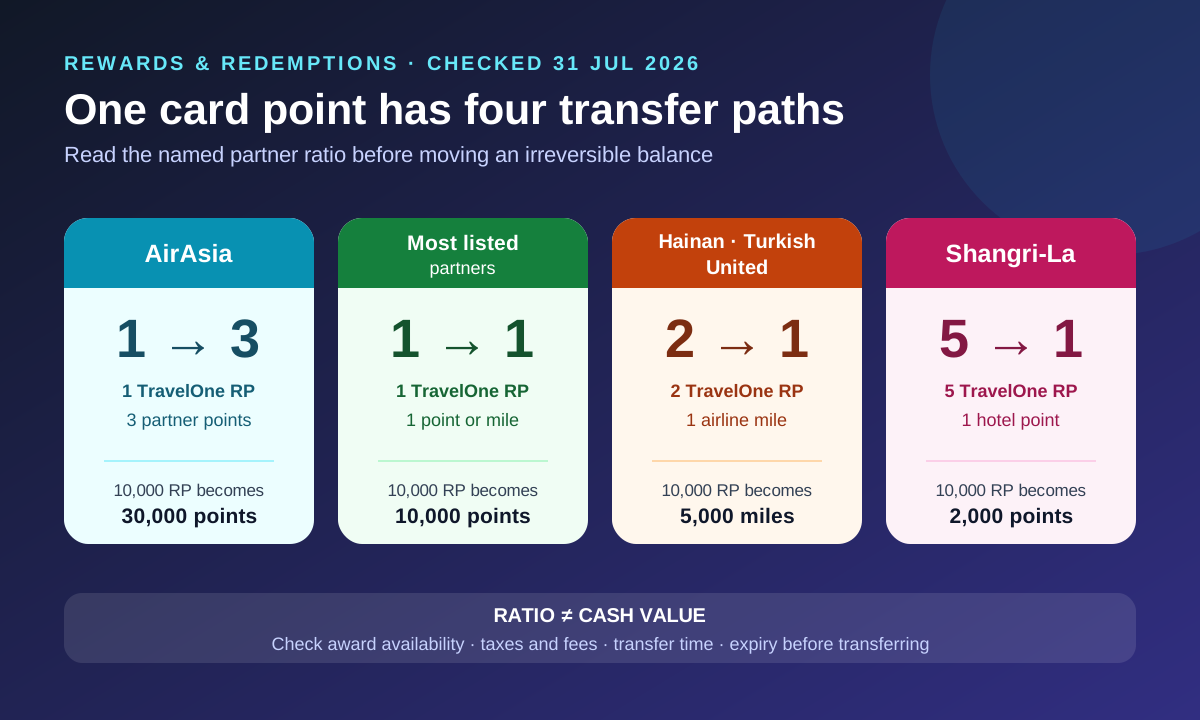
Airline or hotel transfers can show a high theoretical value, but the result depends on award availability, transfer ratios, programme changes and taxes. Do not assign a value from a premium flight you would never buy with cash.
For a transfer route, record:
- card-points-to-partner-points ratio;
- minimum transfer block;
- transfer fee and tax;
- whether transfer is reversible;
- award inventory for the dates you can use;
- cash price of a genuinely comparable booking;
- taxes and surcharges still payable.
Transfer only after checking availability when the programme permits that sequence. A high points balance in a partner account is not useful if there is no suitable award.
Account for refunds and reversals
Rewards from a purchase can be reversed when the transaction is refunded or converted to EMI. That can produce a negative points balance if you redeem first. Check the statement and programme ledger rather than assuming the original earn is permanent.
If a purchase is refunded near a statement date, our refund-after-bill guide explains the payment side. Reward reversal and card-balance adjustment are separate entries and may post on different dates.
Compare cashbacks and instant discounts correctly
Cashback usually has an easier face value, but it can still be capped, delayed, restricted to a wallet or excluded from some transactions. An instant discount reduces the purchase at checkout; points create later conditional value. Use the instant discount, cashback and points comparison to compare all three on timing and certainty.
Frequently asked questions
Is one point equal to one rupee?
Only when the issuer’s current terms for your chosen route say so. Never infer value from the word “point”.
Should I always choose the highest value-per-point route?
No. Choose the highest net value among things you would actually buy, considering availability, effort, expiry and risk.
Do redemption fees matter for small redemptions?
Yes. A fixed ₹99 fee reduces a ₹500 redemption by almost 20% before tax, but has a smaller percentage effect on a larger redemption.
Can I use the issuer’s listed retail price for merchandise?
Use the lower realistic market price for the same item and terms. A catalogue’s reference price may not equal the cash you save.
Should I hoard points for a future premium redemption?
Only if expiry, programme-change risk and expected availability are acceptable. Points are not deposits and their terms can change.
What happens to points when I close a card?
Programme rules differ. Check and redeem or transfer, if appropriate, before closure; do not assume points survive.
The practical answer
Pick two or three redemption routes you can genuinely use. Price the same benefit in cash, subtract every fee and difference, calculate value per point, then calculate the realised reward rate on eligible spend. Also check expiry and minimums.
The most honest point valuation is not the programme’s maximum possible claim. It is the repeatable value you can obtain for a purchase you would otherwise make.
Issuer materials checked on 31 July 2026. Source material was paraphrased; earning, redemption and expiry rules can change.