Checked 4 August 2026 against Axis Bank's card revision notices and ICICI Bank's published upcoming-changes page.
Dynamic currency conversion is the offer you get at a foreign card terminal, or on a foreign website, to be billed in Indian rupees instead of the local currency. The screen usually frames it as a convenience: you see a rupee figure, so you know what you are paying.
The charge behind that convenience has been repriced twice in 2026. ICICI Bank's revised DCC schedule took effect from the 15 January 2026 statement. Axis Bank's takes effect on 28 August 2026. On the bulk of both portfolios, the rate is now 3.5%.
This piece sets out what each issuer publishes, what the two forex charges on a card actually are, and how to work out which option costs less. It is not a claim that DCC is always worse — on two of the cards below it is priced under the typical cross-currency markup.
What the two charges are
A card can levy two distinct markups on a foreign transaction, and they apply in the alternative rather than together:
| Applies when | Set by | |
|---|---|---|
| Cross-currency markup | You are billed in the merchant's local currency and your issuer converts it | Your card's own terms |
| Dynamic currency conversion markup | You are billed in Indian rupees at a foreign merchant, or at an India-located merchant registered abroad | Your card's own terms, separately |
Both are stated before tax. Neither is the exchange rate: a DCC transaction also involves a rate chosen by the merchant's payment provider rather than by the card network, and that rate is not published in advance anywhere you can check at the counter.
This is the part that makes DCC hard to evaluate honestly in the moment. You can compare the two published markups. You cannot compare the two exchange rates, because only one of them is disclosed to you.
Published DCC rates
Axis Bank, from 28 August 2026
| Card | Revised DCC markup | Prior rate stated in the notice |
|---|---|---|
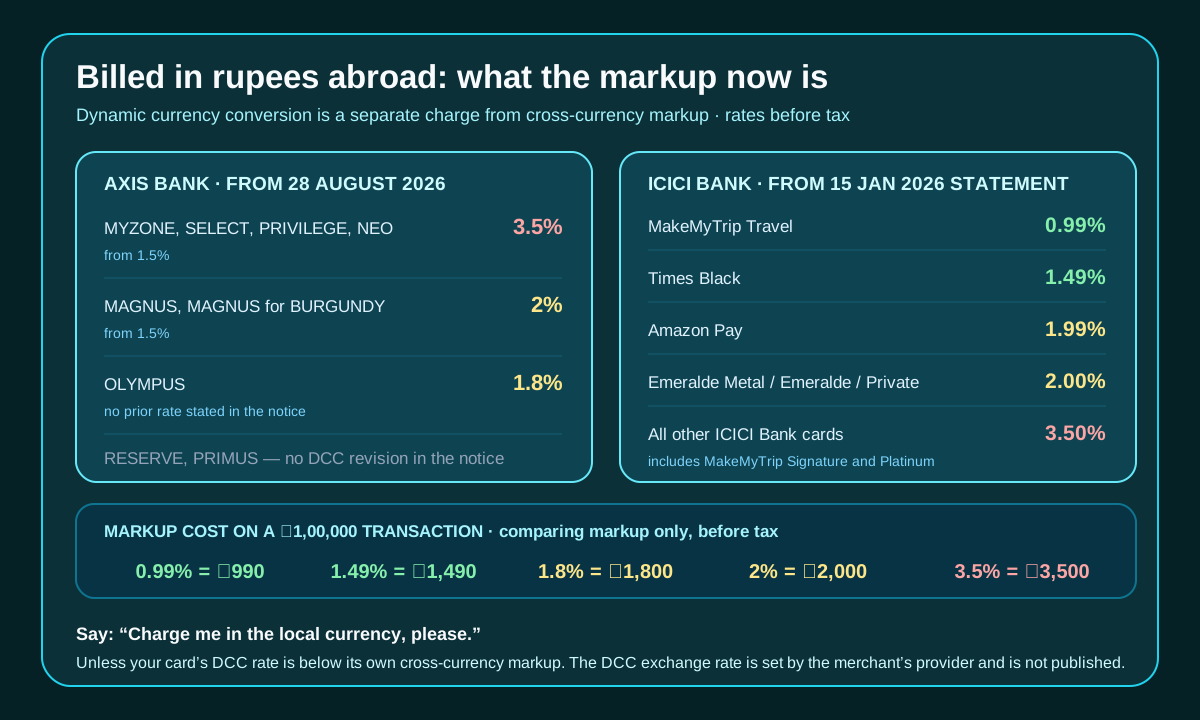
| MYZONE, SELECT, PRIVILEGE, NEO | 3.5% | 1.5% |
| MAGNUS, MAGNUS for BURGUNDY | 2% | 1.5% |
| OLYMPUS | 1.8% | None stated |
| RESERVE, PRIMUS | No DCC revision in the notice | — |
ICICI Bank, from the 15 January 2026 statement
| Card | DCC markup |
|---|---|
| MakeMyTrip ICICI Bank Travel | 0.99% |
| Times Black ICICI Bank | 1.49% |
| Amazon Pay ICICI Bank | 1.99% |
| Emeralde Metal, Emeralde, Emeralde Private | 2.00% |
| All other ICICI Bank credit cards, including MakeMyTrip Signature and MakeMyTrip Platinum | 3.50% |
Two observations. First, both issuers converge on 3.5% as the default and reserve lower rates for premium or co-branded products — the pattern is a tiered fee, not a flat one. Second, ICICI's cheapest DCC rate of 0.99% on the MakeMyTrip Travel card is below most cross-currency markups in the market, which means on that specific card the rupee option can be the cheaper one. A blanket rule of "always decline DCC" is not accurate across these two portfolios.
Not established here: we have not verified a comparable published DCC schedule for HDFC Bank, SBI Card, IDFC FIRST or Kotak, so this piece makes no claim about them. Their MITC and schedule of charges are the documents to check.
The arithmetic
Assume a purchase with a local-currency price equivalent to ₹1,00,000, no exchange-rate movement between the two options, and compare markup only. Tax applies on top of each figure.
| DCC markup | Markup cost |
|---|---|
| 0.99% | ₹990 |
| 1.49% | ₹1,490 |
| 1.8% | ₹1,800 |
| 2.00% | ₹2,000 |
| 3.50% | ₹3,500 |
For an Axis MYZONE, SELECT, PRIVILEGE or NEO cardholder, the move from 1.5% to 3.5% is ₹2,000 more on this transaction. Over a two-week trip with ₹2,00,000 of card spend routed through DCC, that is ₹4,000 before tax — for a service whose only benefit is seeing a rupee figure on a receipt.
The comparison that decides the choice is DCC markup against your own card's cross-currency markup, not against zero. If your card charges 3.5% cross-currency and 3.5% DCC, the markup comparison is a wash and the undisclosed exchange rate becomes the whole question. If your card charges 1.99% cross-currency and 3.5% DCC, declining is clearly indicated. Our zero-forex explainer sets out what a "zero markup" card still charges, because several costs survive either choice.
Where DCC appears when you are not abroad
The definition both issuers use covers more than overseas travel. ICICI's wording is that DCC applies "on each transaction performed in Indian Currency at international location or transactions performed in Indian currency with merchants located in India but registered in a foreign nation". Axis's notices use materially the same formulation.
The second limb is the one that surprises people. A subscription, an app-store charge or a SaaS invoice billed in rupees by an entity registered abroad can attract DCC without you leaving the country or seeing a currency prompt. There is no terminal to decline at, and the transaction reads as a rupee charge to a familiar brand name on the statement.
The only reliable way to identify it is after the fact, on the statement, as a separate markup line against a rupee-denominated transaction. If you find one, the MCC explainer covers how merchant classification is determined and who determines it.
What to do at the terminal
The sentence that works is short: "Charge me in the local currency, please."
| Situation | Action |
|---|---|
| POS terminal offers INR or local currency | Choose local currency, unless your card's DCC rate is below its cross-currency markup |
| Terminal has already printed an INR slip | Ask for it to be voided and re-run in local currency before signing |
| Foreign website defaults to INR at checkout | Look for a currency selector; it is often on the payment step, not the cart |
| Statement shows a DCC markup on a rupee charge | Check whether the merchant is registered abroad before disputing |
A merchant is not obliged to offer you the choice on every rail, and some online checkouts genuinely have no selector. Where the choice exists, it is yours to make, and the receipt should show which currency was billed.
What to check before your next trip
- Your card's cross-currency markup, from its own terms — not from a comparison page.
- Your card's DCC markup from 28 August 2026 (Axis) or from the 15 January 2026 statement (ICICI).
- Whether either figure is stated before or after tax, and at what rate.
- Whether any rupee-billed recurring charge on your statement is carrying a DCC markup.
Then keep a dated copy of the document you read it in. Both issuers serve these terms from URLs that are updated in place.
Primary sources
- Axis Bank MYZONE revision notice
- Axis Bank SELECT revision notice
- Axis Bank NEO revision notice
- Axis Bank MAGNUS revision notice
- Axis Bank OLYMPUS revision notice
- ICICI Bank: upcoming changes to credit card features and charges
Frequently asked questions
Is dynamic currency conversion the same as my forex markup?
No. They are separate charges that apply in the alternative. DCC applies when you are billed in rupees at a foreign merchant or at an India-registered-abroad merchant; the cross-currency markup applies when you are billed in the local currency.
Should I always decline DCC?
Not on every card. On ICICI's MakeMyTrip Travel card the published DCC rate is 0.99%, which is below most cross-currency markups. Compare your own card's two rates rather than applying a blanket rule.
Does a lower DCC rate mean the transaction is cheaper overall?
Not necessarily. DCC also uses an exchange rate set by the merchant's payment provider, and that rate is not published where you can check it at the counter. A favourable markup can be offset by an unfavourable rate.
Can I be charged DCC without travelling?
Yes. Both issuers' definitions cover rupee transactions with merchants located in India but registered in a foreign nation, which can include subscriptions and app-store charges.
Does GST apply on top of these rates?
Both issuers state their markups as fees, with tax as notified by the Government of India applying over and above. Check the exact rate and treatment on your own statement.
Which cards did Axis not reprice?
The RESERVE and PRIMUS notices contain no DCC revision. That is an absence in the notice, not a statement that the rate is nil — check the current schedule of charges for those cards.
This is neutral reporting of published fee schedules, not tax or personal financial advice. Rates and definitions can change after publication, so read your card's own current terms before relying on either figure.