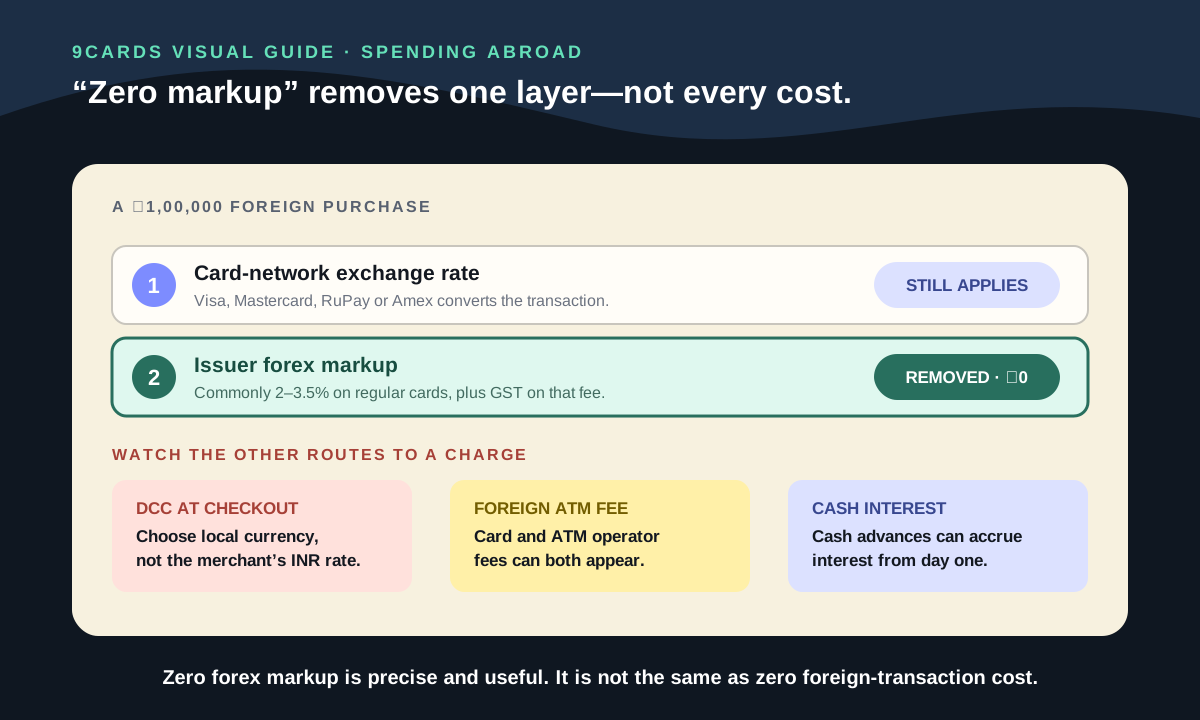
"Zero forex markup" is a real benefit and a genuinely good reason to pick a card for travel. It is also a claim about one line on your statement, and there are six.
A foreign currency transaction on an Indian card is assembled from several separate charges levied by several different parties. A zero-markup card removes exactly one of them: the issuer's own. Knowing which of the others remain is what stops the card being oversold to you, including by yourself.
The layers of a foreign transaction
| Cost layer | Who sets it | Removed by a zero-markup card? |
|---|---|---|
| Network conversion rate | The card network | No |
| Issuer forex markup | Your issuer | Yes — this is the benefit |
| GST on the markup | Statute | Yes, because there is no markup left to tax |
| Dynamic currency conversion rate | The merchant's payment processor | No |
| Issuer's DCC markup | Your issuer, priced separately from the forex markup | Usually not |
| ATM fee and same-day interest | Issuer and ATM operator | No |
Two of those are worth understanding properly, because they are the ones people can actually control.
What the markup waiver is worth
Markups typically sit around three to three and a half per cent, with GST applied on top of the markup itself. That combination is why the effective cost is higher than the percentage suggests.
Here is the arithmetic on ₹1,00,000 of equivalent spending abroad, comparing an illustrative 3.5% markup card against a zero-markup card. GST is shown at 18%, which is the rate applicable to the markup component at the time of writing; the fee schedule is the place to confirm it.
| 3.5% markup card | Zero-markup card | |
|---|---|---|
| Converted spend at network rate | ₹1,00,000 | ₹1,00,000 |
| Issuer markup | ₹3,500 | ₹0 |
| GST on the markup | ₹630 | ₹0 |
| Total charged | ₹1,04,130 | ₹1,00,000 |
Just over ₹4,100 on a ₹1,00,000 trip. On a single holiday that is a meaningful saving and on regular travel it compounds quickly. The benefit is not marketing — it is simply not the whole bill.
The charge you can avoid for free
Dynamic currency conversion is the one worth knowing about, because it is entirely avoidable and it can cost more than the markup you just eliminated.
When a card machine abroad, or a foreign website, offers to bill you in rupees instead of the local currency, that is dynamic currency conversion. The exchange rate is set by the merchant's payment processor rather than by your card network, and it is generally worse — sometimes considerably worse. It is frequently presented as a convenience, occasionally as the default, and it is neither.
Always choose the local currency. Pay in euros in Europe, in baht in Thailand, in dollars in the United States. Your card handles the conversion at the network rate, and on a zero-markup card that is the whole cost.
There is a second layer that is easy to miss, and it is the one that catches people out. Accepting rupee billing does not only swap your network's exchange rate for a worse one. Issuers commonly levy a DCC markup of their own on top, as a line in the schedule of charges that is separate from the forex markup. A rupee-billed transaction can therefore carry the processor's poor rate and a percentage fee from your own bank.
Because the two are priced independently, a card sold on its forex benefit can still charge you for DCC, and the DCC rate can be revised without the forex markup changing at all. Issuers have also been moving the two rates towards each other. Where they end up equal, rupee billing loses even its theoretical appeal: the percentage you pay your bank is the same either way, and you are left holding the processor's worse exchange rate for nothing.
The reason all this matters especially on a zero-markup card is that the saving has been moved somewhere your benefit cannot reach. Your issuer waived its forex markup; that waiver does not extend to a third-party processor's exchange rate, and it does not necessarily extend to the issuer's own DCC fee either. Look for a separate DCC line in the schedule of charges rather than assuming the forex benefit covers it. Accepting DCC on a zero-markup card can hand back everything the card was chosen for.
Cash is a different product
The markup waiver applies to spending. Withdrawing foreign currency at an ATM is a cash advance, and it is priced accordingly.
There is normally a withdrawal fee, often a percentage with a minimum, and interest begins on the day of withdrawal with no interest-free period. Those charges are unaffected by a zero-markup benefit. If you need cash abroad, a small number of larger withdrawals costs less in fees than many small ones, and paying by card wherever it is accepted costs less than either.
Acceptance decides whether any of this matters
A favourable markup on a card that is declined at the counter is worth nothing. Acceptance depends on the network rather than the issuer, and it varies by country, by merchant and between physical terminals and local online checkouts.
The arrangement that works for most travellers is unglamorous: a primary card on a widely accepted network for everyday spending, a second card on a different network kept somewhere else, and a modest amount of local cash for the places that take nothing. That covers a declined transaction, a blocked card and a lost wallet, all of which are ordinary events on a long trip rather than unlucky ones.
It is also worth telling your issuer you are travelling, or setting the travel flag in the app if there is one. A fraud system that has never seen a transaction from you outside your home city is doing its job when it declines the first one.
The short version
- A zero-markup card removes the issuer markup and the tax on it. That is worth roughly four per cent of what you spend abroad.
- It does not improve the network's conversion rate, which is not the mid-market rate you see quoted online.
- Always decline being billed in rupees. This is the single highest-value habit and it is free.
- Cash withdrawals keep their fee and start accruing interest immediately, markup waiver or not.
- Carry a backup card on a different network, stored separately.