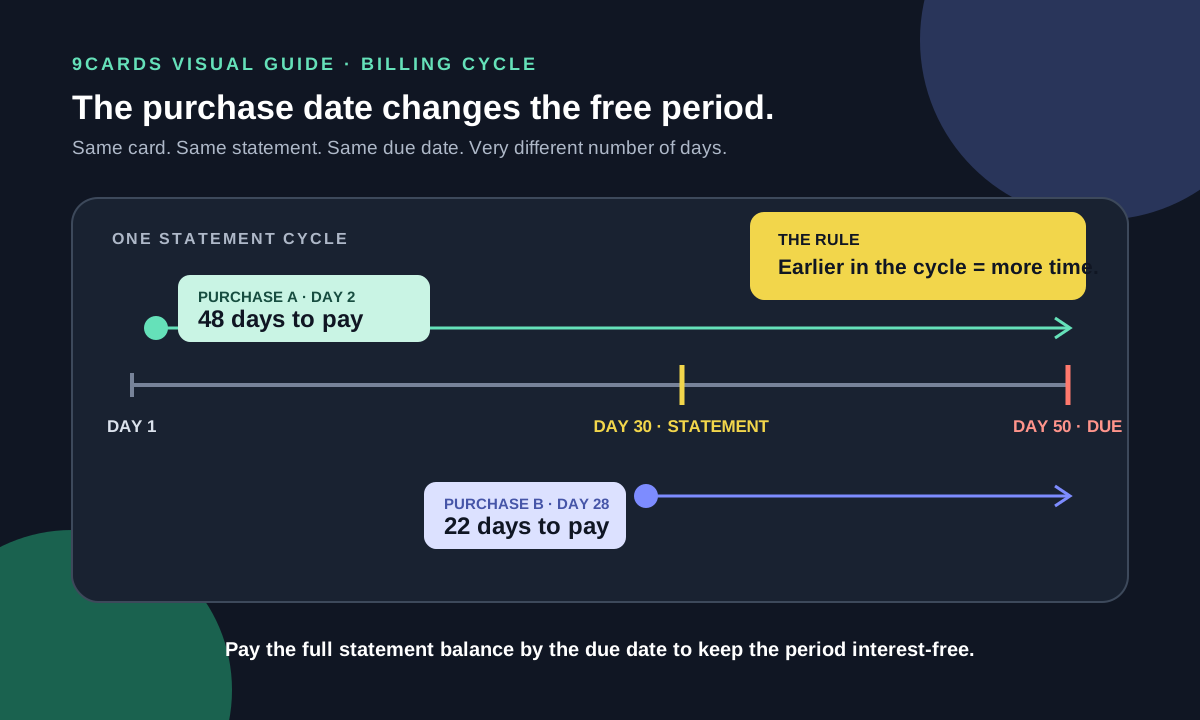
Two people hold the same card. One buys a laptop and has fifty days before the money is due. The other buys the same laptop, two days later, and has twenty. Neither of them did anything wrong and neither card is behaving unusually. This is simply how a billing cycle works, and it is probably the most useful thing to understand about a credit card that nobody explains at the point of sale.
Three dates, not one
A credit card runs on three dates that repeat every month.
| Date | What happens | Typical spacing |
|---|---|---|
| Statement date | The cycle closes and your bill is generated | Fixed day each month |
| Due date | Payment must reach the issuer | Usually 15 to 20 days after the statement |
| Next statement date | The following cycle closes | About 30 days later |
Your interest-free period is the gap between making a purchase and the due date of the statement it lands in. Because the statement date is fixed and your purchases are not, that gap changes with every transaction.
The same purchase, four different outcomes
Take a card with a statement date of the 30th and a due date of the 20th of the following month. Here is what the interest-free period looks like depending on when you buy.
| Purchase date | Lands in statement | Payment due | Interest-free days |
|---|---|---|---|
| 2 April | 30 April | 20 May | 48 |
| 15 April | 30 April | 20 May | 35 |
| 29 April | 30 April | 20 May | 21 |
| 1 May | 31 May | 20 June | 50 |
The 29 April purchase and the 1 May purchase are two days apart and twenty-nine days apart in what they give you. This is why "my card gives me fifty days interest free" is only true for purchases made on exactly the right day. The honest version is that the card gives you somewhere between about twenty and about fifty days, depending on timing.
For a small purchase this is trivia. For a large planned one — a flight, a laptop, an insurance premium — knowing your statement date is worth real money in retained interest, and it costs nothing to look up.
Where the interest-free period disappears entirely
The grace period comes with one condition that is easy to miss: it applies only if you pay your statement in full.
Pay the full amount and you owe no interest on purchases. Pay anything less — including the minimum due — and on most cards the interest-free treatment stops applying, not only to the remaining balance but to new purchases in the next cycle as well, until the balance is cleared completely. The card stops being a payment instrument and becomes a loan, at a rate that is usually quoted per month.
This is the single most expensive misunderstanding in consumer credit. The minimum due is presented as the amount you need to pay, and it is, in the narrow sense that paying it avoids a late fee. It does not avoid interest, and it does not preserve the grace period.
| What you pay | Late fee | Interest on the balance | Grace period on new purchases |
|---|---|---|---|
| Full statement balance | None | None | Retained |
| More than minimum, less than full | None | Charged | Usually lost until cleared |
| Minimum due only | None | Charged | Usually lost until cleared |
| Less than minimum | Charged | Charged | Usually lost until cleared |
The pattern is worth reading twice. The only row that keeps you out of interest is the first one.
Cash withdrawals have no grace period at all
Withdrawing cash on a credit card is a separate product with separate terms, and it is worth treating as a last resort.
There is normally a withdrawal fee charged immediately, and interest begins accruing on the day of the withdrawal rather than from the statement date. There is no interest-free period to lose, because there was never one to begin with. The same treatment usually applies to anything the issuer classifies as a cash equivalent, which can include wallet loads and certain payment transfers.
Two practical things to do
Neither of these takes long, and between them they cover most of the value in this article.
- Find your statement date. It is on every statement and in your card app. Once you know it, you can time a large discretionary purchase to sit just after it, which maximises the interest-free window at no cost.
- Set autopay to the full statement balance, not the minimum. This is the default that protects the grace period. Minimum-due autopay looks prudent and is the mechanism by which a manageable balance becomes an expensive one.
If a balance has already built up and clearing it in full is not realistic this month, that is a different problem from the one this article describes, and the arithmetic of it depends on your circumstances. It is worth a conversation with someone qualified to look at the whole picture rather than a decision made from a card's terms alone.
Why the cycle is designed this way
None of this is a trick. A fixed statement date is the only practical way to bill a revolving account, and a grace period that depends on paying in full is what makes the interest-free period possible at all — the issuer earns from interchange on your spending, and from interest on balances that revolve.
Understanding the mechanism just moves you into the group the arrangement works well for. A card paid in full every month, timed sensibly, is one of the cheapest ways to pay for things. The same card paid to the minimum is one of the most expensive.