Airport lounge access used to be a straightforward feature. The card had it or it did not, and if it did, you walked in. Over the past few years most Indian issuers have moved to a different model, and the benefit is now conditional on your spending in a way that is easy to miss until you are standing at the desk being turned away.
How a spend gate works
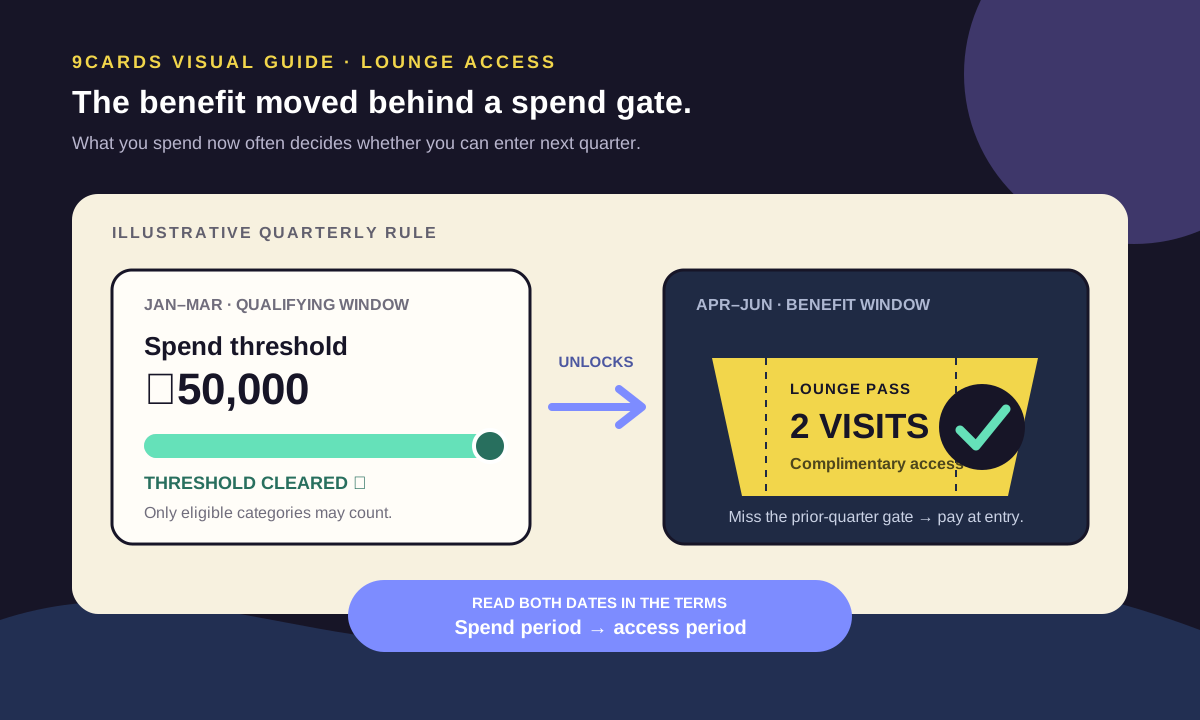
Under a spend gate, the visits available to you in a quarter are earned by your spending in the previous quarter. Clear the threshold and you have access next quarter. Miss it and the benefit is simply absent for three months.
| Quarter you spend in | Spend against threshold | Quarter access applies | Visits available |
|---|---|---|---|
| Jan – Mar | Cleared | Apr – Jun | Full allowance |
| Apr – Jun | Missed | Jul – Sep | None |
| Jul – Sep | Cleared | Oct – Dec | Full allowance |
| Oct – Dec | Cleared | Jan – Mar | Full allowance |
Read the second row again, because it is the one that catches people. The spending happened in April, May and June. The consequence arrives in July, August and September. By the time you are affected, the quarter that caused it is over and there is nothing to be done about it.
What makes this genuinely difficult is that there is usually no notification. Nothing arrives to say the threshold was missed. The card's benefits page continues to list lounge access as a feature, because it is one, conditionally. Most people discover the gap in person.
Why issuers made the change
This is not arbitrary, and it is worth understanding because it explains where the model is heading.
The issuer pays the lounge operator for each visit. On a free or low-fee card, unconditional access is a fixed and unpredictable cost set against interchange revenue that may be very small if the cardholder barely uses the card. A handful of holders who never spend but visit lounges monthly can cost more than the card earns.
A spend gate converts the benefit from a cost into a reward for cardholders who generate revenue. Seen that way it is a rational adjustment rather than a withdrawal, and it is the reason unconditional access now tends to sit on cards with a fee attached, where the fee funds it directly.
Domestic and international are separate allowances
These are almost always different benefits delivered through different programmes, and holding one does not imply the other.
| Domestic access | International access | |
|---|---|---|
| Typically delivered by | A domestic lounge aggregator | A global lounge programme membership |
| Counted | Separately | Separately |
| Usable at international terminals | Generally no | Yes |
| Guest policy | Usually charged or counted against you | Usually charged |
| Shared across your cards | Sometimes, via one membership | Often, via one membership |
The last row is the one that surprises people who collect cards. Where access is delivered through a shared programme membership, several of your cards can draw on a single pool of visits rather than each adding its own allowance. Three cards do not necessarily mean three times the access.
When paying a fee is the cheaper option
Because paid lounge entry has a known price, this is one of the few card benefits you can price exactly. Multiply the walk-in cost by the number of times you would genuinely use a lounge in a year, then compare that to an annual fee for unconditional access.
| Lounge visits per year | Cost at ~₹1,200 walk-in | Sensible conclusion |
|---|---|---|
| 2 | ₹2,400 | A fee for access rarely pays; consider paying per visit |
| 6 | ₹7,200 | A moderate annual fee usually pays for itself |
| 12 | ₹14,400 | A fee card with unconditional access is clearly cheaper |
| 20+ | ₹24,000 | Worth choosing a card specifically for this |
The walk-in figure is indicative and varies by airport and lounge; use whatever your usual airport charges. The structure of the comparison is what matters.
There is a second conclusion hiding in that table. If you are considering manufacturing spending to clear a quarterly threshold, stop and price it. Spending an extra ₹30,000 you did not need to spend, to unlock two lounge visits worth ₹2,400, is not a saving even if the lounge is free at the point of entry. Chasing a gate almost always costs more than the benefit returns.
What to do about it
- Find the threshold and the qualifying quarter. Both are in the card's benefits terms. One without the other is not usable information.
- Check near the end of each quarter, not the beginning of the next one. That is the only point at which you can still influence the outcome.
- Confirm whether your allowance is per card or per membership if you hold several cards with lounge benefits.
- Assume guests are charged unless the terms say otherwise, and check the guest rate before you arrive with family.
- Verify the lounge is still in the programme. Participation at any given airport changes, and a lounge listed last year may have left.
Where this is going
The direction of travel across the market has been consistent: fewer unconditional benefits on free cards, more benefits tied to spending or to a fee that funds them. Lounge access was simply the most visible example, because it is the benefit people notice being refused.
That is not entirely bad news. A benefit funded by a fee you chose to pay is more durable than one funded by cross-subsidy, and it is less likely to be withdrawn at short notice. It does mean the honest question about lounge access is no longer "does this card have it" but "what do I have to do to keep it, and is that worth doing".