Source check: 9 September 2026. RBI announcements: 4 September 2026. Penalty orders: 31 August 2026. The amounts and findings below are taken from the three individual RBI releases.
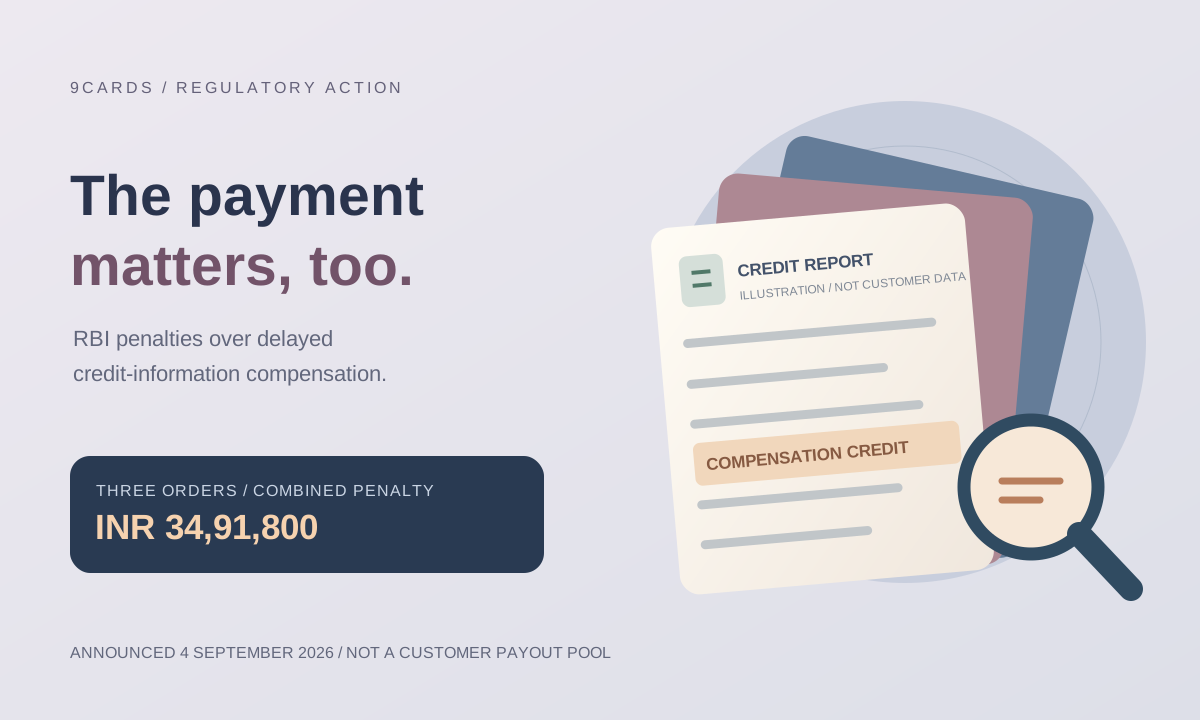
RBI has announced penalties against TransUnion CIBIL, CRIF High Mark and Equifax for non-compliance with its compensation framework for delayed updating or rectification of credit information.
The sustained finding in each release is specific: the company failed to credit compensation to the bank accounts of certain eligible complainants within the prescribed period. This is not an announcement of a new weekly credit-reporting rule, and it does not say that every person with a credit report is entitled to a payout.
Across the three orders, the penalties add up to INR 34,91,800, or INR 34.918 lakh. That combined figure is our arithmetic from RBI's individual amounts, not a separate fourth penalty.
The three orders
| Credit-information company | Regulatory penalty | Order date | Announcement date |
|---|---|---|---|
| TransUnion CIBIL Limited | INR 26,82,800 | 31 August 2026 | 4 September 2026 |
| CRIF High Mark Credit Information Services Private Limited | INR 6,89,600 | 31 August 2026 | 4 September 2026 |
| Equifax Credit Information Services Private Limited | INR 1,19,400 | 31 August 2026 | 4 September 2026 |
| Combined total, calculated | INR 34,91,800 | Not a separate order | Not a separate order |
The difference between the order date and the publication date is worth preserving. The enforcement news became public through the 4 September releases, while the orders were made on 31 August. Neither date should be presented as the date on which every underlying customer problem occurred.
RBI says the inspections referred to the companies' financial positions as of 31 March 2025. That inspection reference is another date in the chronology, not evidence that all affected complaints arose on that particular day.
What RBI found, and how it reached the orders
Each release identifies non-compliance with the compensation framework for delayed updating or rectification of credit information. RBI issued show-cause notices and considered the companies' written replies and oral submissions at personal hearings. The CIBIL and CRIF releases also refer to further submissions.
The regulator cites section 25(1)(iii), read with section 23(4), of the Credit Information Companies (Regulation) Act, 2005, as its authority for the monetary penalties.
These process details matter because the report is about published regulatory findings, not an allegation inferred from social-media complaints. Equally, the releases do not establish an intention to withhold payments or supply a complete account of each consumer's dispute. We have not attributed motives that RBI did not state.
A fine is not a customer compensation fund
The penalty amounts are sanctions against the companies. None of the three releases announces that those amounts will be divided among credit-report users or that readers can apply for a share.
A customer's entitlement to compensation is a separate question under the applicable framework and the facts of their complaint. The announcement of a regulatory penalty does not itself establish that a particular reader qualifies.
There are also two different outcomes to track in an existing case: whether the inaccurate or delayed credit information has been dealt with, and whether any compensation due has been credited. A corrected report is not, by itself, evidence that a separate payment obligation has been satisfied.
Our credit reporting and compensation explainer covers the wider mechanism. This article reports the new enforcement event rather than presenting that existing mechanism as a fresh September benefit.
What the announcements leave unanswered
RBI does not disclose the number of affected complainants, the amounts owed to individual customers, the exact length of each delay, or whether every outstanding compensation payment has since been made. A larger penalty should not be converted into an invented customer count.
The releases also state that the actions concern deficiencies in regulatory compliance and do not pronounce on the validity of customer transactions or agreements. They are not findings that every credit score issued by these companies is wrong, nor do they cancel a customer's existing borrowing obligations.
Those boundaries prevent two misleading conclusions: that the problem is irrelevant once a fine has been imposed, or that the fine proves every customer has suffered the same failure.
What matters to a customer with an unresolved case
Keep the original complaint, acknowledgement, follow-up correspondence, report-correction status and any compensation communication together. When following up, distinguish a request to rectify information from a request for an overdue compensation credit.
Do not assume a new complaint is unnecessary because RBI has already penalised the company. The public releases do not identify every eligible recipient or confirm the status of a particular case. Equally, there is no need to pay an intermediary merely because a message promises access to a supposed pool of these fines.
The news is a concrete enforcement action over payment compliance. It reinforces the importance of checking both the report and the compensation outcome without promising an automatic award to readers.