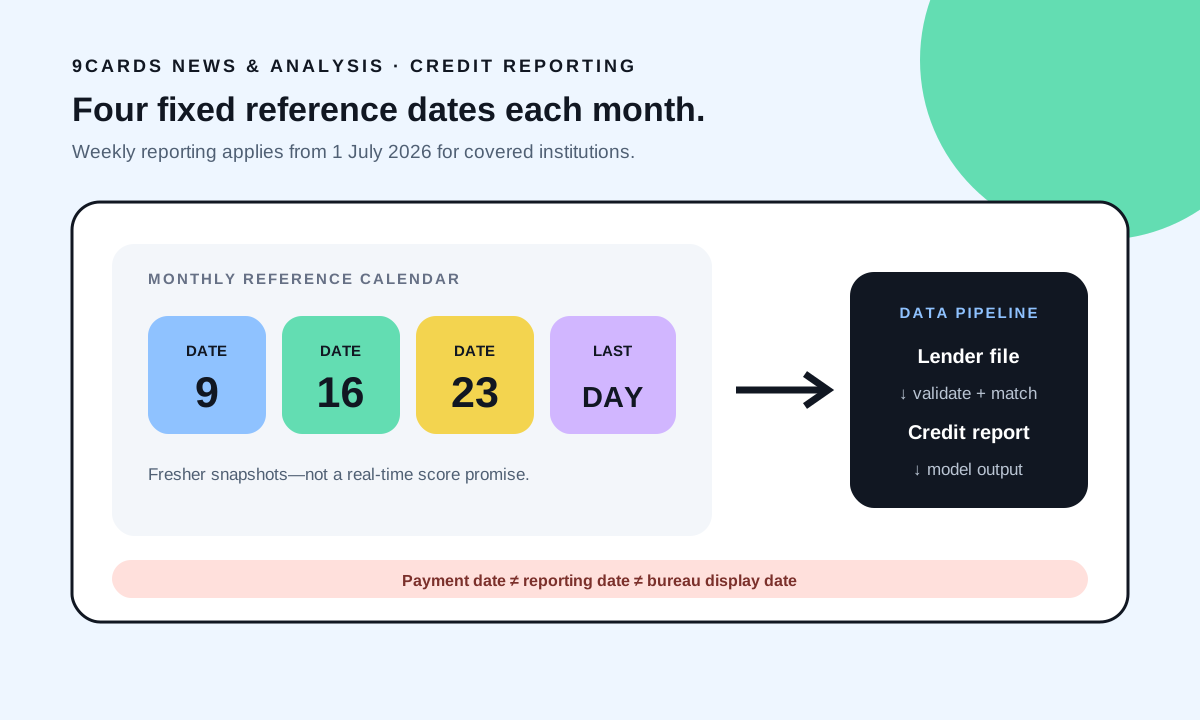
India's credit-information system moved to a faster rhythm on 1 July 2026. Covered credit institutions now report on fixed weekly reference dates—the 9th, 16th, 23rd and last day of each month—under RBI's amended credit-information reporting framework. This replaced the fortnightly baseline that had applied from 1 January 2025.
The change should reduce how long a repayment, new account or changed balance waits for the next reporting snapshot. It does not guarantee that every credit report or score changes on the same day you pay. The lender must record the event, create the correct file, send it, and the credit information company (CIC or credit bureau) must ingest and match it. A score can also remain unchanged even when the underlying account data updates.
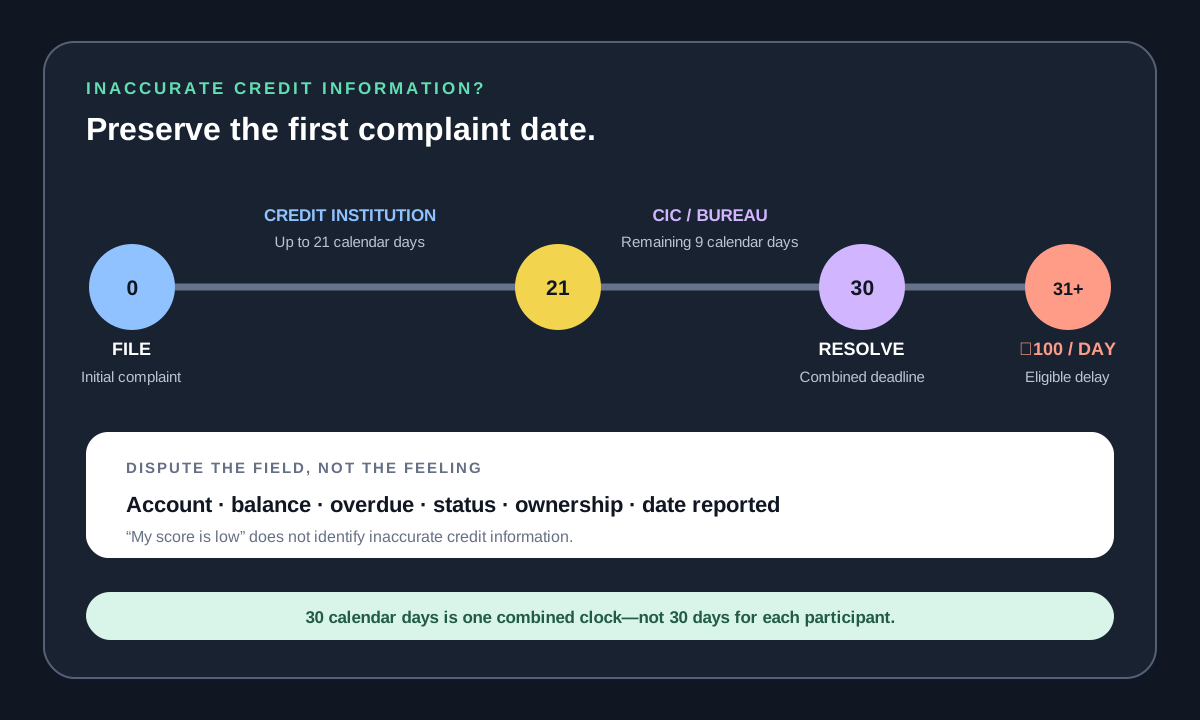
A separate RBI compensation framework covers delayed correction of inaccurate credit information. Where an eligible complaint is not resolved within 30 calendar days, the complainant can be entitled to ₹100 for each calendar day of delay. Faster routine reporting and complaint compensation solve different problems.
The reporting timeline changed twice
RBI first accelerated the old monthly cycle in 2024, then tightened it again through the 2025 directions and amendments.
| Regulatory stage | Reporting reference rhythm | Effective date | What changed for borrowers |
|---|---|---|---|
| Earlier baseline | Commonly monthly | Before 2025 | A payment could wait much of a month for the next snapshot |
| RBI August 2024 circular | Fortnightly, as of the 15th and month-end, or shorter agreed intervals | 1 January 2025 | Two regular opportunities each month |
| 2025 consolidated directions | Entity-specific credit-information rulebooks | 28 November 2025 | Requirements were reorganised by regulated-entity type |
| December 2025 amendments | Fixed weekly reference dates: 9th, 16th, 23rd and last day | 1 July 2026 | Four regular reference dates each month |
RBI's live NBFC Credit Information Reporting Directions, 2025 contain reporting, correction, customer-service and compensation chapters for that regulated-entity class. RBI also issued corresponding directions and amendments for other institution types; the Urban Co-operative Banks amendment states the 1 July 2026 commencement for its amended reporting framework.
Use the direction applicable to the lender. One NBFC or co-operative-bank document is evidence of the harmonised direction of policy, but it is not a substitute for identifying the regulated entity involved in a complaint.
Weekly reporting does not mean real-time scoring
The 9th, 16th, 23rd and last day are data reference points. They are not four guaranteed consumer-facing score refresh appointments.
A simplified flow is:
- You make a payment or the lender changes an account status.
- The lender posts that event to its own servicing system.
- The account is included in the relevant reporting file or incremental update.
- A CIC validates, ingests and matches the file to a consumer record.
- The report reflects the new account data.
- A score is recalculated under that CIC's model when requested or refreshed.
A delay or mismatch can occur at more than one stage. Weekends, file rejection, identity fields, an unsettled card payment, a payment made just after a reference cut-off, or a lender's correction workflow can affect visibility.
This is why “my score did not rise in seven days” is not proof of non-compliance. First ask whether the account data changed: current balance, amount overdue, days past due, date reported, account status and payment history. The score is an output built from report data and a model, not the field the lender directly sends as a promised number.
What weekly reporting can improve
The faster cadence can reduce stale-data windows in several common situations.
| Event | Potential benefit of more frequent reporting | Remaining limitation |
|---|---|---|
| Credit-card bill paid | Lower balance can reach bureaus sooner | Statement, payment and reporting cut-offs may differ |
| Loan closed | Closed status need not wait for a full monthly cycle | Closure must first be completed correctly by lender |
| New loan disbursed | Other lenders see fresh exposure sooner | Matching and ingestion still take time |
| Missed payment | Delinquency can also appear sooner | Faster reporting is not only beneficial news |
| Error corrected | Corrected file has more frequent route to CIC | Complaint investigation remains necessary |
| Card utilisation reduced | New reported balance can lower displayed utilisation sooner | Score response is not fixed or guaranteed |
The same speed that helps a repaid balance appear can make a new borrowing or overdue amount visible sooner. It is a data-freshness rule, not a score-boost scheme.
Our credit-utilisation guide explains why statement balance, credit limit and reporting date matter. There is no authoritative promise that reducing utilisation by a given percentage adds a fixed number of points.
Routine delay versus inaccurate information
Separate these before filing a complaint.
- Routine lag: you paid recently and the next file/ingestion cycle has not completed.
- Unsettled payment: the card issuer has not yet credited the payment to the account.
- Accurate historical late mark: the report correctly records a past delinquency; paying later does not make the history erroneous.
- Inaccurate current data: balance, overdue, ownership, status or payment history is wrong.
- Identity mismatch: another person's account or duplicated record appears because data was matched incorrectly.
- Correction delay: lender or CIC accepted a dispute but did not complete the required rectification in time.
The ₹100-per-day framework is about delayed updation or rectification after an eligible complaint—not compensation whenever a score fails to move as hoped.
How the 30-day correction clock works
RBI's compensation framework gives the credit institution (CI)—the lender or reporting institution—and the CIC a combined 30 calendar days to resolve a correction complaint. The division is generally:
| Responsible participant | Regulatory window | Typical job |
|---|---|---|
| Credit institution | 21 calendar days | Investigate source records and send corrected/additional information |
| Credit information company | Remaining 9 calendar days | Process the lender response and update the credit information |
| Combined resolution period | 30 calendar days from initial filing | Complete the eligible complaint |
| Delay beyond combined period | ₹100 per calendar day | Compensation allocated according to the participant causing delay |
TransUnion CIBIL's framework-for-compensation page identifies RBI circular RBI/2023-24/72 dated 26 October 2023 and explains the compensation framework from a CIC's operating perspective. The RBI framework became effective six months after the circular, in April 2024.
The 21-plus-9 split does not give the complainant two separate 30-day clocks. The total is 30 calendar days from the initial complaint filing. If a complaint starts with a CIC, it must route the issue to the relevant credit institution; if it starts with the lender, the necessary correction still has to reach the CIC.
What ₹100 per day does—and does not cover
Compensation accrues for an eligible unresolved complaint beyond the 30-calendar-day period. It is not an automatic fine paid for every disagreement with a report.
The framework does not mean:
- ₹100 for each day since the original transaction;
- ₹100 because a loan application was declined;
- guaranteed damages equal to a claimed financial loss;
- removal of accurate negative information;
- a fixed score increase after correction;
- compensation before the complaint and bank details are properly recorded.
When multiple institutions contribute to delay, responsibility can be apportioned. The customer should be told how the complaint was resolved and, where applicable, the compensation calculation. Keep the initial filing date because that anchors the clock.
How to file a credit-report correction cleanly
1. Obtain the report and identify the exact field
Use the report's dispute or control number, account identifier, lender name, date reported and field that is wrong. “My score is low” is not a correctable field. “Account ending 1234 shows ₹8,500 overdue although the attached no-dues letter dated 3 July shows zero” is.
2. File with the CIC and the lender
Use official dispute channels. Filing with both creates visibility, but avoid opening many inconsistent complaints for the same item. Cross-reference the complaint numbers.
3. Attach source evidence
Useful evidence can include statements, payment confirmations, closure/no-dues letters, identity documents through secure channels, and earlier issuer responses. Redact unrelated account numbers when possible.
4. Record the initial filing date
Save acknowledgement emails, screenshots and ticket numbers. Calendar days include weekends for the 30-day framework; do not substitute “working days” in your own timeline.
5. Check the corrected field, not only the score
Download or refresh the report after resolution. Confirm balance, overdue, status, dates and ownership. A score may react differently across CICs because each can use its own model and data refresh.
6. Claim compensation through the documented process
If the eligible complaint exceeded 30 calendar days, ask the CI/CIC for the delay calculation and payment status. Provide bank details only through verified official channels. Escalate a rejected or unresolved grievance through the applicable mechanism, including RBI's complaint route where maintainable.
Credit cards: when should a payment appear?
A card payment first has to settle to the issuer. If you paid close to a due date, the bill-payment rail and issuer credit date determine whether it was on time. Credit-bureau reporting is a later step.
Then ask which balance is reported. Card issuers commonly report a periodic account snapshot, not every purchase and payment as a live feed to consumers. A payment made after the statement can reduce the next reported balance, but the exact snapshot depends on the issuer's reporting file.
For late-payment effects, see our credit-card late-payment and CIBIL guide. For a card closed correctly but still shown open, use the written closure confirmation from our closure checklist as dispute evidence.
Frequently asked questions
Are credit scores updated every seven days now?
The rule establishes fixed weekly credit-information reporting reference dates. Consumer-facing report ingestion and score calculation can follow after those snapshots, so “every seven days exactly” is too strong as a personal guarantee.
Which dates are used?
The amended framework uses the 9th, 16th, 23rd and last day of each month as fixed reference dates for covered credit-institution reporting from 1 July 2026.
Did fortnightly reporting end?
It was the baseline from 1 January 2025. The weekly amendment superseded that cadence for covered institutions from 1 July 2026, though shorter intervals and operational details depend on the applicable direction.
Will paying off a card increase my score immediately?
No fixed increase or timing is guaranteed. The lower balance must be reported and ingested, and the score model considers the wider file.
When does ₹100-a-day compensation start?
For an eligible delayed correction complaint, it begins after the combined 30-calendar-day resolution period, calculated from the initial filing date under the framework.
Should I dispute an accurate late payment?
No. The correction process is for inaccurate or incomplete information. Ask the lender to explain any genuinely disputed payment-date evidence, but do not describe accurate history as an error.
Do I need to complain to every CIC?
Reports can differ because each CIC holds data received and matched in its system. Check the affected report and use its dispute process while involving the reporting lender. A correction in one system should not be assumed visible everywhere instantly.
The practical answer
Weekly reporting is a meaningful freshness improvement, not real-time credit scoring. From July 2026, covered institutions work to four fixed reference dates each month. Check the account fields and date reported before concluding that an update failed.
When information is wrong, file a precise complaint with evidence, preserve the initial date and track the combined 30-calendar-day clock. The ₹100-per-day rule is a remedy for delayed rectification, not a reward for a score that did not change.
RBI and CIC materials checked on 31 July 2026. Credit-information directions are entity-specific and can be amended; use the live direction applicable to the reporting institution.