Credit-card fees, reward rates, lounge lists, eligibility rules and limited-period offers change frequently. A page that was accurate when researched can become incomplete after an issuer revises its terms. Readers are therefore an important part of keeping 9Cards useful—but a correction must be precise enough to verify.
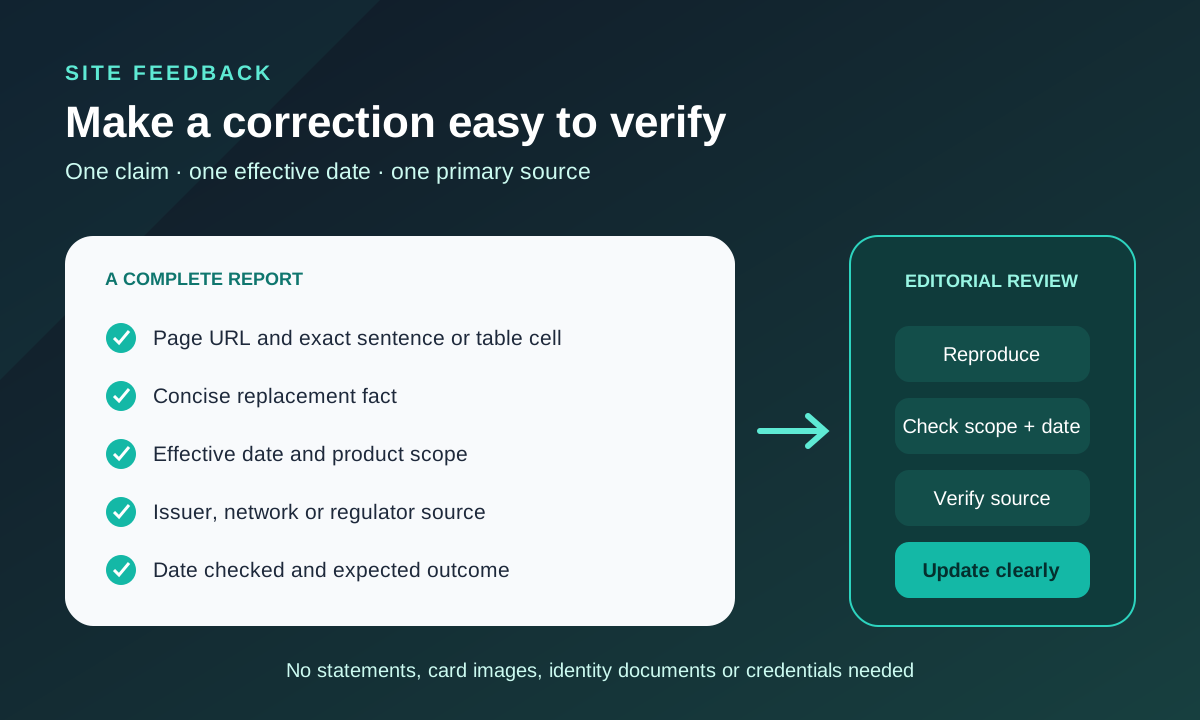
“Your information is wrong” tells us where concern exists but not what to change. A strong report includes the page, exact sentence or table cell, replacement fact, effective date and a primary source.
What to include
Use this checklist for a correction or site-feedback message:
| Field | Useful detail |
|---|---|
| 9Cards page | Full URL or article title |
| Exact claim | Quote a short sentence or name the table row |
| Problem type | Outdated, factually wrong, ambiguous, broken link or display issue |
| Correct information | Concise replacement wording or value |
| Effective date | Date the new term began, if available |
| Primary source | Issuer, network, regulator or programme URL/PDF |
| Product scope | Exact card variant, network and customer segment |
| Evidence date | When you accessed or downloaded the source |
| Desired outcome | Correction, clarification, source update or technical fix |
Do not attach complete statements, card images, identity documents, OTPs or account credentials. We do not need personal financial data to correct public product information.
Prefer primary sources
The strongest source is usually the organisation responsible for the rule:
- issuer MITC, schedule of charges or official product page for fees;
- issuer reward-programme terms for earn, cap and expiry rules;
- card-network and issuer programme documents for lounge lists;
- RBI notification, direction or FAQ for regulatory requirements;
- merchant and issuer offer terms for a promotion.
For example, RBI publishes current credit-card directions and an official credit-card FAQ. Visa publishes a participating airport lounge list. Each source answers a different question: the Visa list does not prove that every Visa card receives access, and an RBI rule does not supply a particular card’s reward rate.
A forum comment, search snippet or comparison site can alert us to a change, but we will try to confirm it from a primary source before rewriting a factual claim.
Include the effective date
A new document does not always mean the old article was wrong on its publication date. It may be a prospective change.
Suppose an issuer announces on 15 July that a fee changes from 1 September. A report should say:
- current fee through 31 August;
- new fee from 1 September;
- announcement date;
- affected card variants;
- whether existing and new customers are treated differently.
That lets us preserve historical context and add the future change accurately. Replacing every old number without dates can make an article less correct.
Separate products that share similar names
Issuers often have multiple variants with similar names, different networks or invitation-only versions. A fee or benefit for one is not evidence for all.
Include:
- exact product name as displayed by the issuer;
- network, if the term is network-specific;
- new versus existing customer scope;
- personal, business or corporate status;
- optional add-on/supplementary card treatment;
- document section or page number.
Avoid sending cropped images that remove the product title, validity date or exclusions. A direct official URL plus page/section reference is more verifiable.
Report an offer differently from a permanent feature
A merchant discount is usually temporary and conditional. An official HDFC Bank SmartBuy offer-detail page illustrates the kind of dated source needed for campaign coverage: validity, booking/payment route and terms matter alongside the headline.
For an offer correction, specify:
- campaign name and issuer;
- validity dates and eligible transaction date;
- merchant/seller and payment route;
- card variants and networks included/excluded;
- minimum spend, rate and maximum benefit;
- whether benefit is instant, delayed cashback or points;
- refund and cancellation treatment.
Our deal-comparison guide explains why those fields cannot be collapsed into one percentage.
Report a data calculation with inputs
If you believe a reward return, fee or cap calculation is wrong, send the inputs rather than only your answer.
| Calculation | Inputs needed |
|---|---|
| Reward rate | Spend unit, points earned, usable point value and cap |
| Cashback cap | Eligible rate, maximum cashback and eligible spend |
| Annual fee waiver | Threshold, measurement period, exclusions and refunds |
| Forex cost | Issuer markup, network conversion, taxes and transaction date |
| Lounge eligibility | Card variant, spend gate, quota, lounge/terminal and programme date |
You can reproduce the issue with hypothetical amounts. No personal statement is required. Use the reward value calculator or annual-fee waiver audit to structure the inputs.
What happens after a report
A responsible editorial review should:
- reproduce the page claim or technical problem;
- open the supplied source and confirm scope/date;
- seek a second authoritative source when ambiguity remains;
- distinguish correction from post-publication change;
- update wording, table, source or link;
- preserve context where a term changed over time;
- reject unsupported or promotional claims;
- record enough evidence for later rechecking.
A source can also conflict with another issuer page. In that case, the correct outcome may be a caveat or a request to the issuer, not an immediate confident replacement.
We do not accept payment for a factual correction, and a correction report should not be used to insert referral links, promotional copy or guaranteed-approval claims.
Technical and accessibility feedback
Site feedback is not limited to card facts. Report:
- broken links or images;
- unreadable tables on mobile;
- keyboard navigation traps;
- missing form labels or unclear focus;
- poor colour contrast;
- incorrect heading hierarchy;
- page crashes or repeated form submissions;
- misleading validation or error text.
Include browser/device, page URL, steps to reproduce, expected result and actual result. A screenshot can help, but remove bookmarks, account names, email addresses and other unrelated personal data.
For a security vulnerability, do not publish exploit details or sensitive data in a public discussion. Use the private contact route and provide the minimum proof needed to reproduce safely.
Frequently asked questions
Is a screenshot enough to correct a card term?
It can show the issue, but an official dated URL or PDF is stronger. Screenshots can omit scope, validity and exclusions.
Can I report personal account treatment as a public product rule?
You can flag it, but one account outcome may reflect a targeted offer, retention decision or processing error. Provide public terms if you want a general page changed.
Will every report produce an edit?
No. We may find that the page already states the correct scope, the source applies to another variant, or the claim cannot be verified. A clear explanation may be the appropriate response.
Should old articles be deleted when terms change?
Usually not. Historical context can remain useful if dates are clear and current guidance is added or linked.
Can issuers request promotional wording?
They can report factual errors using the same evidence standard. Editorial wording and conclusions remain independent.
What if an official link is broken?
Send the old URL, document title, publisher and any replacement/archive location. We can update the citation while preserving what it supported.
A copy-and-send template
- Page URL/title:
- Exact sentence/table field:
- Issue: outdated / incorrect / ambiguous / broken / technical
- Proposed fact or expected behaviour:
- Effective date:
- Primary source URL and section/page:
- Exact product/network/customer scope:
- Date source checked:
- Optional reproduction steps:
A precise report is faster to review, safer for readers and easier to revisit when terms change again. It also keeps a correction from accidentally applying one product’s rule to an entire issuer.
Linked regulatory, network and issuer materials checked on 31 July 2026. Source material was paraphrased; the cited pages should be rechecked when submitting a correction.