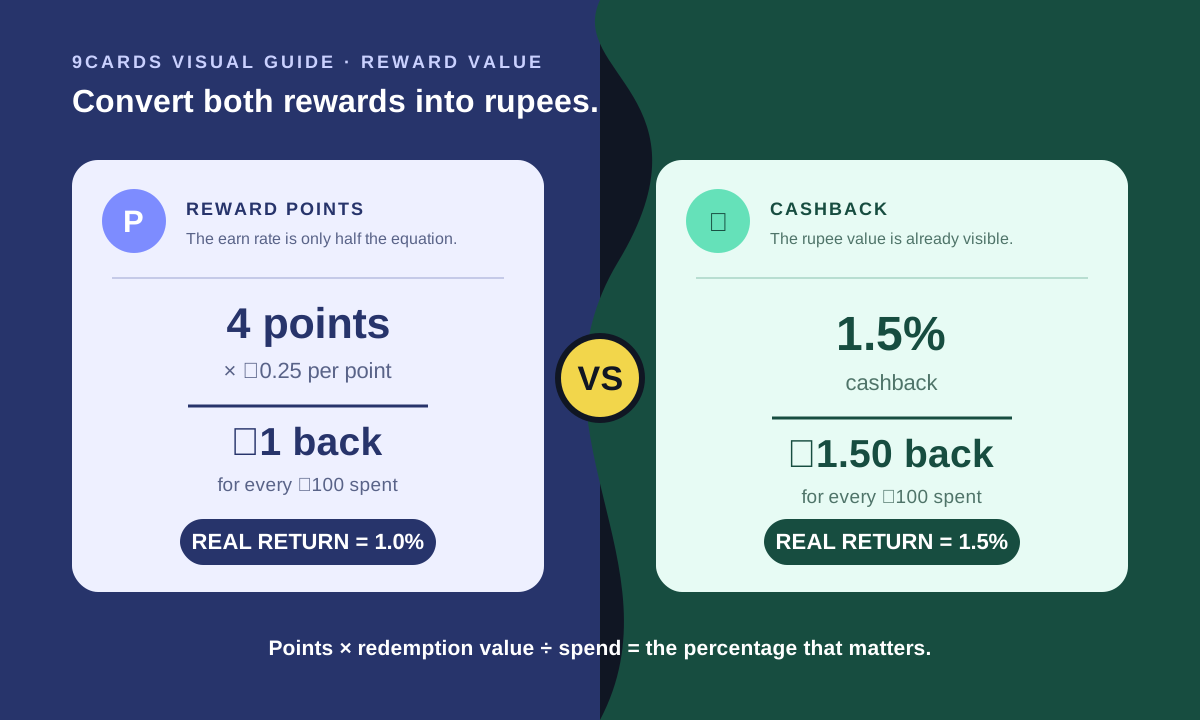
A card offering four reward points per ₹100 sounds strictly better than a card offering one and a half per cent cashback. Four is a bigger number than one and a half, and the comparison feels settled.
It is not settled, because points and rupees are different units. Four points per ₹100 is a rate only once you know what a point is worth, and that number is set by the redemption options rather than by the earning rate. Two cards with identical earn rates can differ by a factor of four in what they actually return.
Converting an earn rate into a real rate
The arithmetic is simple. Points earned per ₹100, multiplied by the value of one point, gives you the return per ₹100 — which is the percentage.
| Points per ₹100 | Value per point | Effective return |
|---|---|---|
| 2 | ₹0.25 | 0.50% |
| 2 | ₹0.50 | 1.00% |
| 4 | ₹0.25 | 1.00% |
| 4 | ₹0.50 | 2.00% |
| 10 | ₹0.25 | 2.50% |
| 10 | ₹0.50 | 5.00% |
Notice the second and third rows. A card paying two points is exactly as good as a card paying four, if its points are worth twice as much. The earn rate on its own tells you nothing.
So the first question about any points card is not how fast it earns. It is what a point is worth when you spend it, and the answer is in the redemption catalogue rather than the marketing.
Where point values come from
Point value is not a single number. It depends on the exit route, and the routes differ sharply in both value and effort.
| Redemption route | Value per point | Effort | Predictable? |
|---|---|---|---|
| Statement credit | Usually the lowest fixed rate | None | Yes |
| Issuer catalogue or portal | Fixed, often modest | Low | Yes |
| Airline or hotel transfer | Potentially the highest | High | No |
| Vouchers and gift cards | Middling, varies by brand | Low | Mostly |
Statement credit is the floor. If a programme lets you convert points to a credit on your bill, that rate is the worst you can do, and it is the honest number to use when comparing against a cashback card. Anything above it requires either a portal or a plan.
Transfers to airline and hotel programmes are where the large numbers live, and they are real. They are also the option most people never use, because extracting outsized value requires flexible dates, award availability, and a willingness to research. Paying a higher annual fee for transfer partners you will not use is a common and expensive mistake.
The comparison that actually matters
| Cashback | Fixed-value points | Transferable points | |
|---|---|---|---|
| Value known in advance | Yes | Yes | No |
| Effort to realise value | None | Low | High |
| Expiry risk | None | Sometimes | Sometimes |
| Devaluation risk | None | Low | Real |
| Ceiling on value | Low | Low | High |
| Lost if you close the card | No | Usually | Usually |
| Suits | Anyone | Most people | Frequent flyers who plan |
Two rows deserve emphasis. Devaluation is a risk that cashback does not have: a programme can change how many points a redemption costs, and points you have already earned are worth less afterwards. Cashback cannot be devalued after the fact. And closure matters more than people expect — unredeemed points are typically forfeited when an account closes, sometimes immediately, so redeeming before you close a card is the correct order of operations.
Expiry is a discount on the earn rate
Many point programmes expire balances after a fixed period. Where they do, the effective rate is lower than the calculation above suggests, because some proportion of what you earn will quietly disappear.
If a programme expires points after three years and you redeem sporadically, assume some leakage and discount the rate accordingly. If a programme has no expiry, that is a genuine feature and worth something, particularly on a card you use lightly.
So which should you choose?
For most people, most of the time, cashback or fixed-value points. The reasons are unglamorous and hold up well: you know what you are getting, there is nothing to manage, nothing expires, and nothing can be devalued after you have earned it. A predictable 1.5% beats a theoretical 3% that requires quarterly attention you will not give it.
Transferable points make sense in one specific case: you fly a few times a year, you are willing to research redemptions, and you would genuinely use premium cabins you would not otherwise buy. In that case the ceiling is high enough to justify both the fee and the effort. Outside it, the flexibility is a feature you are paying for and not using.
A reasonable arrangement for most households is one no-fee flat-rate card as the default, and at most one specialist card wherever spending genuinely concentrates. That covers the ordinary cases without an annual fee for a programme nobody has time to optimise.
Before you compare two cards
- Find the statement-credit rate per point. That is the floor and the fair basis for comparison.
- Multiply it by the earn rate to get a percentage you can compare with a cashback card.
- Check whether points expire, and after how long.
- Check whether the good rate needs a portal, and whether you would actually use it.
- Check what happens to the balance if you close the card.
Do that and the four-points-versus-one-and-a-half-per-cent question answers itself, usually in a way that surprises whoever was quoting the bigger number.