Checked 4 August 2026 against the nine Axis Bank card-specific revision notices linked below.
Axis Bank has published separate "Revision of … Credit Card Terms and Conditions" notices for MYZONE, SELECT, PRIVILEGE, NEO, MAGNUS, MAGNUS for BURGUNDY, OLYMPUS, RESERVE and PRIMUS. They share a headline effective date of 28 August 2026, and three of the changes carry later dates of 1 October, 1 November and 15 November 2026.
This is not one portfolio-wide announcement with a single set of terms. The notices overlap but do not match, and two of the nine cards are missing changes that the other seven carry. Reading a summary of "the Axis changes" and applying it to your card is the mistake this piece exists to prevent: the notice naming your card is the document that governs it.
We previously logged the DCC increase and held the ₹1,300 late-payment slab and the toll exclusion as review due because they were not in the general MITC we could read on 30 July. Both are now confirmed in the card-specific notices, and one detail in our earlier note was wrong — corrected below.
What changes on 28 August 2026
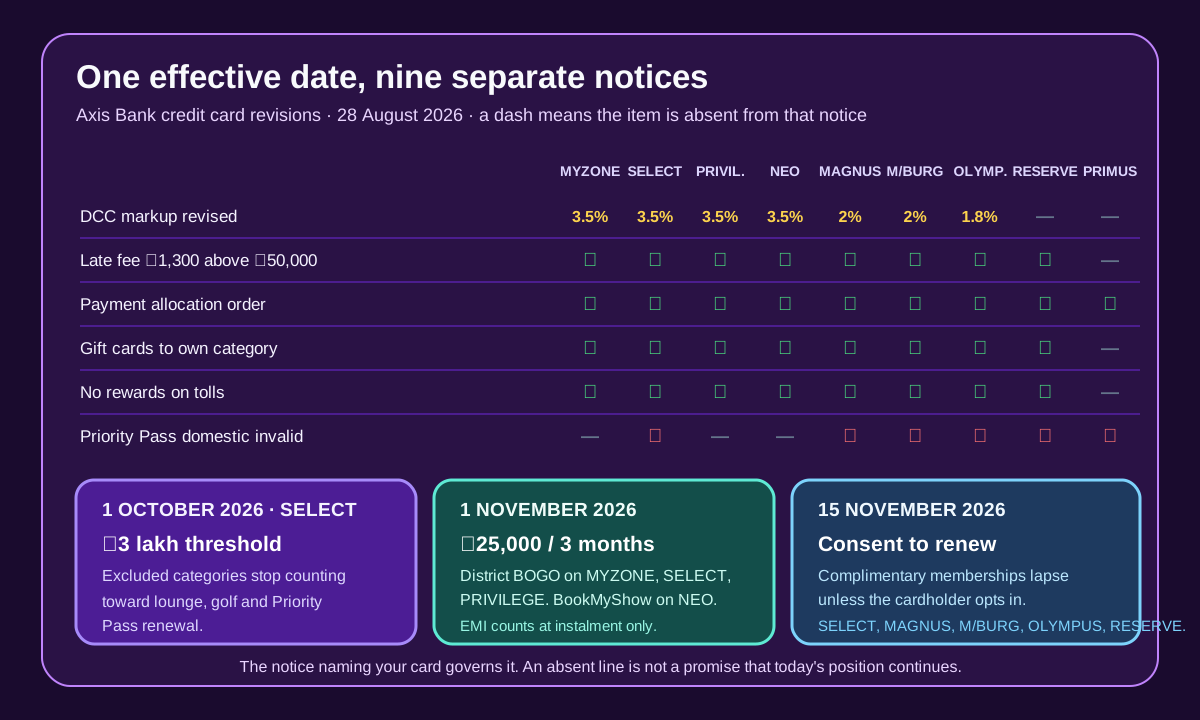
| Change | MYZONE | SELECT | PRIVILEGE | NEO | MAGNUS | MAGNUS for BURGUNDY | OLYMPUS | RESERVE | PRIMUS |
|---|---|---|---|---|---|---|---|---|---|
| DCC markup revised | 3.5% | 3.5% | 3.5% | 3.5% | 2% | 2% | 1.8% | — | — |
| Late-payment fee ₹1,300 above ₹50,000 | ✓ | ✓ | ✓ | ✓ | ✓ | ✓ | ✓ | ✓ | — |
| Payment allocation order stated | ✓ | ✓ | ✓ | ✓ | ✓ | ✓ | ✓ | ✓ | ✓ |
| Gift cards moved to their own spend category | ✓ | ✓ | ✓ | ✓ | ✓ | ✓ | ✓ | ✓ | — |
| No rewards on bridge fees, road fees and tolls | ✓ | ✓ | ✓ | ✓ | ✓ | ✓ | ✓ | ✓ | — |
| Priority Pass invalid at Indian domestic lounges | — | ✓ | — | — | ✓ | ✓ | ✓ | ✓ | ✓ |
A dash means the item does not appear in that card's notice, which is not the same as a statement that the current position continues. PRIMUS carries only the payment-allocation paragraph and the Priority Pass guidance; RESERVE carries everything except a DCC revision.
Dynamic currency conversion
For MYZONE, SELECT, PRIVILEGE and NEO the notices read "Dynamic Currency Conversion markup will be revised to 3.5% from 1.5%". MAGNUS and MAGNUS for BURGUNDY move "to 2% from 1.5%". The OLYMPUS notice says only "will be revised to 1.8%" and states no prior figure.
Correction to our 30 July note. We wrote that these rates apply "where DCC is nil today". That was wrong for six of the seven cards: the notices state an existing 1.5% for MYZONE, SELECT, PRIVILEGE, NEO, MAGNUS and MAGNUS for BURGUNDY. Only OLYMPUS has no prior rate stated in its notice, and absence of a figure is not the same as a rate of nil. The change-log line has been corrected.
DCC is the markup applied when you let an overseas merchant, or an India-located merchant registered abroad, bill you in rupees instead of the local currency. It is separate from the cross-currency markup that applies when you pay in the foreign currency. On a ₹1,00,000 equivalent transaction, comparing markup only and assuming no exchange-rate movement, 1.5% is ₹1,500 and 3.5% is ₹3,500 — a ₹2,000 difference before applicable tax.
The practical effect is that on the four 3.5% cards, choosing "pay in INR" at a foreign terminal stops being a cheaper option than declining it. What you pay instead depends on your card's own cross-currency markup, which these notices do not revise. Our zero-forex explainer sets out which costs survive either choice.
The ₹1,300 late-payment slab
Eight of the nine notices carry an identical table, and identical framing: the fee "remains unchanged for outstanding balances below INR 50,000", and above that becomes ₹1,300.
| Slab of outstanding amount | Late-payment fee |
|---|---|
| Less than ₹500 | Nil |
| ₹501 to ₹5,000 | ₹500 |
| ₹5,001 to ₹10,000 | ₹750 |
| ₹10,001 to ₹50,000 | ₹1,200 |
| More than ₹50,000 | ₹1,300 |
So this is a single new top band rather than a repricing. A cardholder who misses a due date on a ₹49,000 balance pays what they would have paid before; at ₹51,000 they pay ₹100 more, plus tax.
Worth noting what this converges on. HDFC Bank's current MITC already charges ₹1,300 above ₹50,000, reached through more bands (₹900 at ₹10,001–25,000, ₹1,100 at ₹25,001–50,000). Axis is not moving ahead of the market here; it is arriving at the same ceiling from a flatter structure.
A drafting gap. The table jumps from "Less than INR 500" to "INR 501 to INR 5000", so an outstanding balance of exactly ₹500 falls in neither band. The same gap appears in all eight notices, which suggests a shared template rather than a per-card decision. It is unlikely to matter often, and we are not going to guess which way it resolves. If it affects a statement, ask in writing and keep the reply.
A late-payment fee is the smaller consequence of a missed due date. The reporting consequence is separate and longer-lived — see late payment and your CIBIL record.
Payment allocation order
All nine notices state the same order. A payment is applied "first towards applicable fees and charges (including taxes), followed by EMIs, interest charges, purchase transactions and cash advances".
This is the one change that appears on every card in the set, and it is the one most likely to be misread as routine. Allocation order decides which part of a balance a partial payment actually clears, and therefore what keeps accruing interest. Fees first and cash advances last means a partial payment does not touch the most expensive component until everything above it is settled. Our payment allocation explainer works through why the order matters more than the total on a revolved balance.
Gift cards and tolls stop earning
Gift-card purchases were already excluded from rewards. What changes is their classification: instead of sitting inside "Wallet", they move to a separate spend category titled "Gift card".
That reclassification is not cosmetic, because the notices attach different consequences per card:
| Card | Gift-card spend also excluded from |
|---|---|
| MYZONE | Milestone benefits |
| SELECT, PRIVILEGE | Spend-based fee waiver and milestone benefits |
| MAGNUS for BURGUNDY, RESERVE | Spend-based fee waiver |
| NEO, MAGNUS, OLYMPUS | No further exclusion stated |
Separately, and on the same eight cards, "no rewards shall be earned on spends made on Bridge Fees, Road Fees & Tolls". This confirms the toll exclusion we held for review on 30 July.
Both changes are classification decisions expressed through merchant category codes, and neither is visible on a statement line that reads only as a merchant name. Our MCC explainer covers how to identify the code behind a transaction before disputing a missing award.
Priority Pass stops working at domestic lounges
Six notices — SELECT, MAGNUS, MAGNUS for BURGUNDY, OLYMPUS, RESERVE and PRIMUS — carry the same paragraph: "Effective 28-08-2026, the Priority Pass card will not be valid for accessing domestic airport lounges in India."
Domestic access does not end. The instrument changes: you present the credit card itself with your boarding pass, not the Priority Pass. International lounges continue on Priority Pass, and the notices add a distinction worth memorising before you travel — lounges at Indian international terminals after immigration count as international, so Priority Pass still works there.
The failure mode this creates is procedural, not contractual: a cardholder who has spent years handing over a Priority Pass at a domestic lounge desk hands over the wrong card and is refused. If that happens, our lounge denial checklist sets out what to record at the desk.
Three later dates
| Effective | Cards | Change |
|---|---|---|
| 1 October 2026 | SELECT | The ₹3 lakh anniversary-year threshold for 6 extra international lounge visits, 6 extra golf rounds and Priority Pass renewal no longer counts spends in excluded categories |
| 1 November 2026 | MYZONE, SELECT, PRIVILEGE | "Buy one get one" free District offer requires ₹25,000 spend in the previous 3 months |
| 1 November 2026 | NEO | 10% instant discount up to ₹100 on BookMyShow requires ₹25,000 spend in the previous 3 months |
| 15 November 2026 | SELECT, MAGNUS, MAGNUS for BURGUNDY, OLYMPUS, RESERVE | Complimentary memberships renew only with explicit cardholder consent |
The SELECT change on 1 October is the most consequential of the four, because it stacks two exclusions. The notice names the categories: "Insurance, rent, fuel, educational services, utilities & telecom, wallet, Gold/Jewellery, government services and gift card". Spends there already earned no reward points; from 1 October they also stop counting toward the ₹3 lakh threshold. A cardholder who reached ₹3 lakh partly through utility and insurance payments may not reach it on the same behaviour.
The 1 November movie-benefit gates share a common rulebook across the three notices that carry them: the spend requirement is waived for the month of card issuance and the following three calendar months; a variant upgrade does not count as new issuance but an additional card does; only transactions settled in the preceding three calendar months count, and settlement can lag the transaction by up to five working days; fees and interest do not count; and an EMI transaction counts only at the monthly instalment billed in that cycle, not at full transaction value.
That last rule is the one most likely to catch someone out. A ₹60,000 purchase converted to EMI does not deliver ₹60,000 of qualifying spend — it delivers one instalment per cycle. Our spend-gate guide covers how to track a rolling window of this shape.
The 15 November consent requirement is the only change in the set that runs in the cardholder's favour, and it needs an action rather than an omission: memberships lapse unless consent is given. Axis says renewal details and consent options will be shared closer to the renewal date.
What to check on a statement
| Step | Capture | Why |
|---|---|---|
| Identify the notice | Card variant, notice title, effective date | Two of nine cards do not carry most of these changes |
| Date the transaction | Transaction date and settlement date | The movie gates count settlement, not transaction |
| Recompute forex | Amount, currency billed, markup applied | Separates DCC from cross-currency markup |
| Re-test thresholds | Category of each qualifying spend | Excluded categories stop counting from 1 October on SELECT |
| Check the instrument | Which card was presented at the lounge desk | Priority Pass is no longer the domestic instrument |
| Archive | Dated PDF, URL, statement, reference number | Notices are replaced in place at these URLs |
The notices at these URLs are live documents that can be updated without a new filename. Save a dated copy of the one that names your card.
Primary sources
All nine are Axis Bank's own card-specific revision notices, checked 4 August 2026:
For the comparison figure: HDFC Bank credit-card MITC.
Frequently asked questions
Does every Axis card get all of these changes?
No. Of the nine notices we can read, PRIMUS carries only the payment-allocation paragraph and the Priority Pass guidance, and RESERVE carries no DCC revision. Cards outside these nine are not covered by these notices at all, and we make no claim about them here.
Is the DCC markup replacing my forex markup?
No. DCC applies when a transaction is billed to you in rupees at an overseas merchant, or at an India-located merchant registered abroad. The cross-currency markup applies when you are billed in the foreign currency. These notices revise DCC only.
Did OLYMPUS previously charge nil DCC?
Unavailable. The OLYMPUS notice states the new rate of 1.8% and no prior rate. We are not inferring one, and our earlier note that said DCC was nil on these cards has been corrected.
Will my late-payment fee go up if I am usually a few thousand rupees late?
Not under these notices. Only the band above ₹50,000 changes, from ₹1,200 to ₹1,300. Every band below ₹50,000 is stated as unchanged.
Can I still use my Priority Pass at an Indian airport?
At international terminals after immigration, yes — the notices classify those lounges as international. For domestic lounges in India, from 28 August 2026 you present the credit card itself.
Does spending ₹25,000 on an EMI purchase unlock the movie benefit?
Not at full value. The notices state that only the monthly EMI instalment billed in the statement cycle counts toward the spend calculation, not the full transaction amount.
This is neutral reporting of published issuer notices, not tax or personal financial advice. These notices are served from URLs that can be updated in place, so recheck the notice naming your card immediately before relying on a benefit, a threshold or a lounge visit.