When a credit-card statement contains several kinds of dues, a payment does not necessarily go to the transaction you had in mind. The issuer applies an order of payment allocation set out in its terms. Tax, instalments, fees, finance charges, balance transfers, retail purchases and cash advances can occupy different positions in that order.
This matters whenever you pay less than the full amount due. You might intend to clear a cash withdrawal or an expensive transfer, but earlier allocation buckets can consume the payment first. The remaining balance then continues under its own interest and fee rules.
There is no safe universal order to memorise. Read the current Most Important Terms and Conditions (MITC) or payment-settlement page for your issuer and card account.
Payment allocation in one sentence
Payment allocation is the rule that maps one incoming payment across multiple components of your outstanding balance.
| Statement component | Why it may be a separate bucket | What to check |
|---|---|---|
| GST or other applicable tax | Tax arose on fees or finance charges | Whether payment clears it before principal |
| EMI amount | Contractual instalment is due this cycle | Whether current EMI ranks before other balances |
| Fees and charges | Late, annual, cash, overlimit or processing fees | Position in allocation order and tax treatment |
| Finance charges | Interest already billed | Whether these clear before transaction principal |
| Balance transfer | Promotional or financed balance | Its position and offer-end consequences |
| Retail purchases | Ordinary posted spending | Oldest-first or other issuer method within the bucket |
| Cash advance | Cash principal with separate pricing | Whether it remains after retail or other categories |
The RBI's current credit-card directions require transparent card terms and statements, but they do not give cardholders one identical allocation sequence across every issuer in the way a simple internet rule might suggest. The issuer disclosure is the operative document for your account.
An issuer-specific example
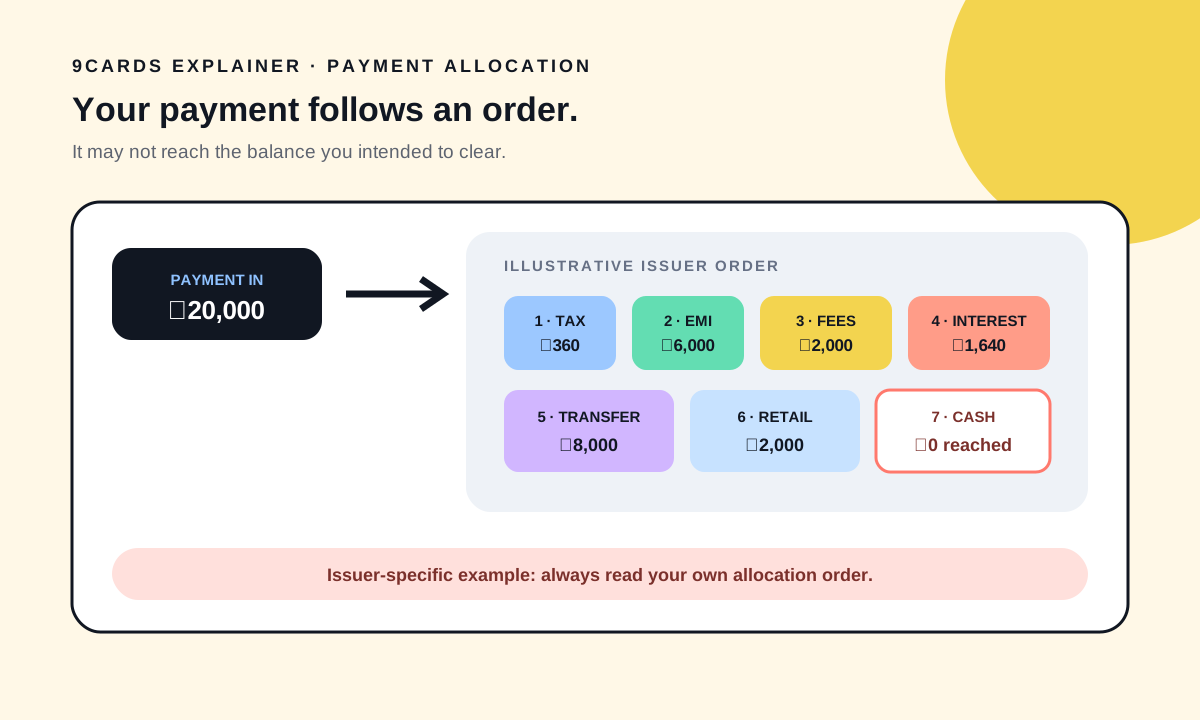
SBI Card currently publishes this sequence on its Order of Payment Settlement page: GST, EMI amount, fees/charges, finance charges, balance transfer, retail spends and cash advance, in that order.
That is a useful real-world example, not a universal Indian credit-card order. Another issuer can use different wording, categories or an internal rule for ordering transactions within each category. Always check your own account terms.
The example demonstrates why intuition can fail. Cash advances often begin attracting finance charges from the transaction date, yet cash principal appears after several other components in this published sequence. A cardholder cannot safely assume that paying the cash amount alone removes it.
Worked example: a payment that does not clear what you expect
Assume an illustrative statement has these components and follows the SBI Card sequence purely for demonstration:
| Component | Statement amount |
|---|---|
| GST | ₹360 |
| EMI due | ₹6,000 |
| Fees/charges | ₹2,000 |
| Finance charges | ₹1,640 |
| Balance transfer | ₹8,000 |
| Retail spends | ₹12,000 |
| Cash advance | ₹5,000 |
| Total | ₹35,000 |
Now assume the cardholder pays ₹20,000, hoping to clear the ₹5,000 cash advance and reduce purchases. Under the example order, the allocation could look like this:
| Allocation step | Payment used | Payment remaining |
|---|---|---|
| GST | ₹360 | ₹19,640 |
| EMI | ₹6,000 | ₹13,640 |
| Fees/charges | ₹2,000 | ₹11,640 |
| Finance charges | ₹1,640 | ₹10,000 |
| Balance transfer | ₹8,000 | ₹2,000 |
| Retail spends | ₹2,000 | ₹0 |
| Cash advance | ₹0 | ₹0 |
The cash principal remains, as do ₹10,000 of retail purchases. The payment was real and reduced total outstanding by ₹20,000, but it did not target the balance the cardholder considered most urgent.
Actual statements can calculate interest daily, apply credits and refunds, order older balances within categories, and add transactions after statement generation. The example is a map of allocation logic, not a payoff quote.
Allocation is not the same as minimum amount due
The minimum amount due tells you the least amount required under the statement to avoid being treated as unpaid for that billing obligation, subject to the issuer's terms. Allocation tells you where any payment received is applied. They answer different questions.
Paying the minimum does not preserve the interest-free period. RBI's credit-card FAQ explains that when the total amount due is not cleared by the due date, interest-free credit can be lost and interest may be levied on the outstanding amount after adjusting payments, refunds and reversals as credited.
Our billing-cycle guide covers that consequence in detail. Allocation explains which outstanding remains after the partial payment; the interest rules determine what that remainder costs.
Allocation is not the same as interest calculation
Three separate operations can occur on one statement:
- The issuer calculates the bill: transactions, instalments, fees, tax and already accrued finance charges are totalled.
- The issuer calculates minimum due: the disclosed formula determines the required minimum.
- The issuer allocates payment: the money received is distributed through the stated order.
After that, interest on remaining eligible balances follows the account's pricing rules. Some balances can have no grace period, promotional rates or different start dates.
This is especially important for cash. Our cash-withdrawal guide explains that a withdrawal can carry an upfront fee and finance charges without the ordinary retail grace period. If allocation leaves cash principal outstanding, its cost does not become harmless merely because a large payment was made.
How refunds and reversals fit in
A refund is a credit, but it is not always treated exactly like a cardholder payment for every purpose. Its effect can depend on whether it relates to the previous billing cycle or the current one, whether the bill was already paid, and what the issuer's rules say.
RBI's FAQ gives examples of credits for refunds, failed transactions and reversals before and after bill generation. Our refund-after-bill guide turns those examples into a payment checklist.
Do not assume an expected refund will target an expensive balance. Wait for it to post, then inspect the updated amount due and balance composition.
Balance transfers and allocation risk
A balance transfer adds another repayment bucket. Depending on the issuer terms, partial payments can clear fees, interest or retail spending before they reduce the transferred principal—or the transfer can rank before retail and leave purchases revolving.
Before accepting a transfer, ask for:
- its exact position in payment allocation;
- the monthly or total repayment schedule;
- whether new purchases retain an interest-free period;
- what rate applies after the promotional end date;
- the foreclosure or closure process;
- the amount required for a full payoff on a chosen date.
Our balance-transfer cost guide explains why the headline rate is incomplete without these answers.
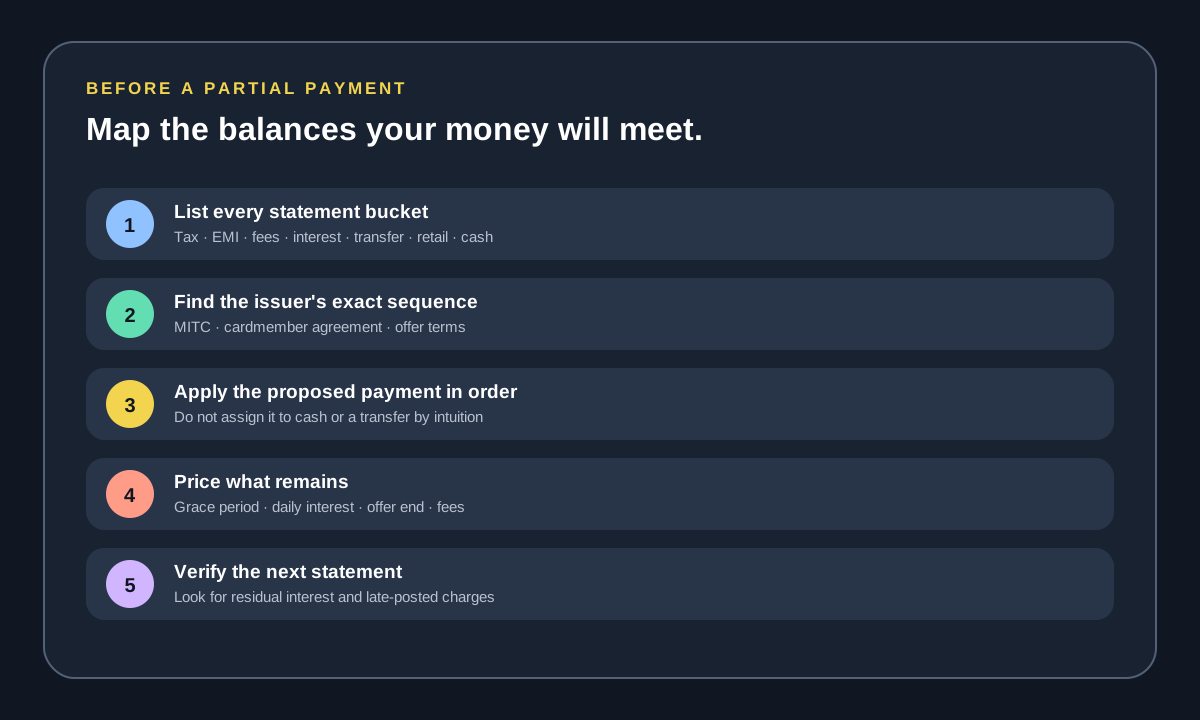
How to find your card's allocation order
Use the issuer's own documents, not a generic blog:
- Download the current MITC and cardmember agreement.
- Search for “payment allocation”, “order of payment settlement”, “appropriation of payments” and “adjusted against”.
- Check whether the document is general or specific to your card/product.
- Compare it with the statement's component breakdown.
- Ask the issuer in writing how a proposed partial payment will be applied.
- When closing an EMI, transfer or cash balance, request a dated payoff amount rather than estimating principal.
Save the terms that applied when you took an offer. Live web pages can change, and promotional facilities may have separate conditions from the base card.
A safer way to manage mixed balances
The cleanest approach is to avoid mixing new retail spending with cash, balance transfers or a revolving balance on the same card. Where that has already happened:
- stop adding discretionary transactions;
- list each balance, rate and fee treatment;
- identify the issuer's allocation sequence;
- request a current full-clearance figure;
- pay the confirmed total if feasible rather than guessing at one component;
- inspect the next statement for residual interest or late-posted charges;
- retain a small buffer before requesting closure.
This is an explanation of mechanics, not personalised debt advice. If full repayment is not realistic, contact the issuer before missing payments and consider qualified help that can review all obligations together.
Frequently asked questions
Can I tell the issuer to apply my payment to cash first?
Usually the disclosed allocation order governs routine payments. You can ask, but do not assume a payment instruction overrides the agreement unless the issuer confirms it in writing.
Does paying exactly the cash-withdrawal amount stop cash interest?
Not necessarily. Earlier buckets may consume the payment, and finance charges may accrue until the cash balance is actually cleared. Request a payoff amount and verify the next statement.
Are older purchases always paid before newer ones?
That depends on the issuer's within-category method. A published top-level sequence may not explain every transaction-level ordering rule. Ask for clarification if it affects a disputed calculation.
Does autopay change payment allocation?
Autopay changes how much and when you pay, not normally the issuer's allocation order. Full-statement autopay avoids most allocation consequences if it succeeds and no later adjustment changes the due.
Can a refund satisfy the minimum due?
A posted credit can reduce outstanding, but its treatment depends on timing and the transaction it relates to. Check the issuer's updated minimum and total due rather than assuming any credit satisfies the obligation.
Why is there a small balance after I paid everything shown?
Residual finance charges can accrue between statement generation and payment, or another fee or transaction can post later. Ask for a current closure amount and inspect the following statement.
The practical answer
A credit-card payment reduces what you owe, but the issuer's allocation terms decide what it reduces first. Whenever tax, EMI, fees, interest, transfers, purchases and cash share one account, read the sequence before making a partial payoff.
The most reliable escape from allocation surprises is a confirmed full-clearance amount followed by a clean statement. Until then, treat “I paid the expensive part” as an intention—not an outcome—unless the account records show that balance actually reached zero.
RBI and SBI Card materials checked on 31 July 2026. The SBI Card sequence is an issuer-specific example; allocation orders and product terms can change.