A credit card limit increase raises the maximum revolving credit available on the account. It can reduce the card's utilisation ratio when the reported balance stays unchanged, but it does not erase debt, guarantee a CIBIL score increase or make a purchase affordable.
You can receive a pre-approved offer, request an increase using income information, or receive a temporary limit for a specific period. Under RBI rules, a permanent enhancement cannot simply be imposed without your explicit consent.
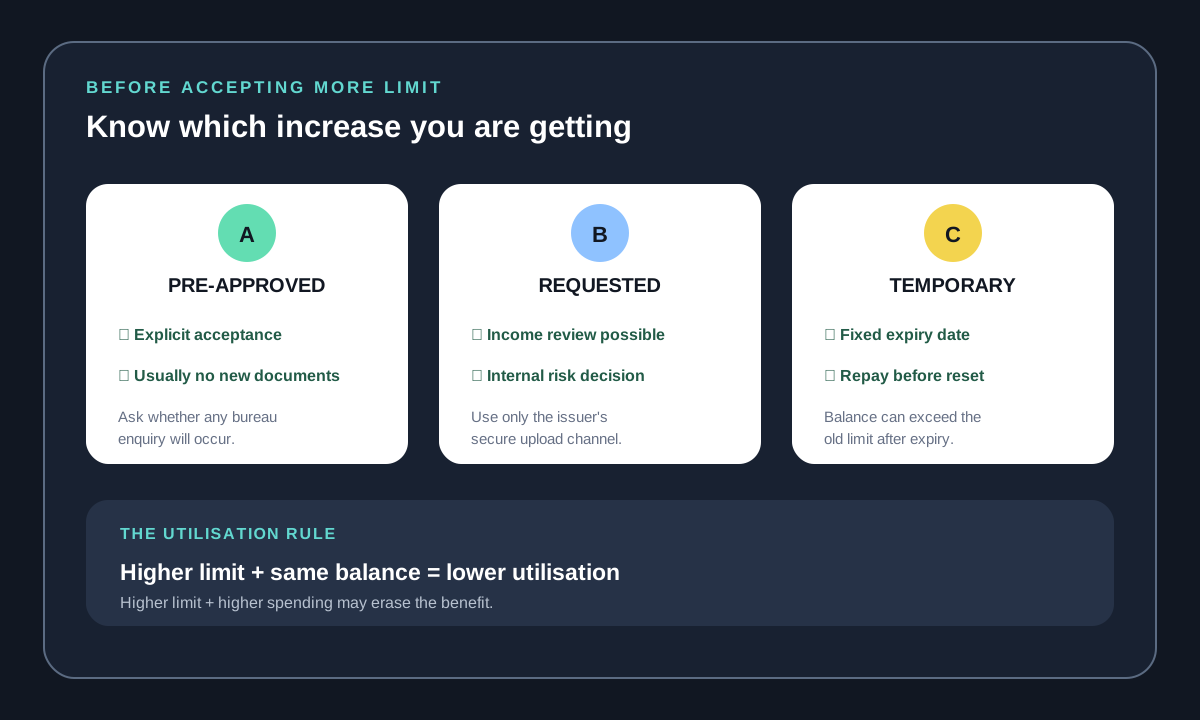
Three types of credit limit increase
| Type | How it starts | Duration | What to verify |
|---|---|---|---|
| Pre-approved permanent increase | Issuer offers under internal policy | Ongoing until reviewed | Consent, new limit and whether any enquiry occurs |
| Requested permanent increase | Cardholder submits request and possibly income data | Ongoing if approved | Documents, credit check, timeline and final limit |
| Temporary limit increase | Issuer offers or approves short-term headroom | Fixed expiry | Expiry date, eligible transactions and repayment needed before reset |
The SBI Card credit-limit increase FAQ, for example, describes zero-document pre-approved offers, document or Account Aggregator-based evaluation, and temporary offers under its internal risk policy. Its channels and documents are issuer-specific.
RBI consent rule for credit limit enhancement
The RBI's current card directions prohibit unilateral credit-limit enhancement without the cardholder's explicit consent. An issuer may make an offer, but the cardholder must accept before the higher limit is implemented.
If your limit changes without consent:
- capture the old and new limit from statements or messages;
- ask the issuer for the consent record and effective date;
- state whether you want the prior limit restored;
- retain the complaint number;
- escalate through the issuer's grievance process if unresolved.
A limit reduction follows different risk and notice provisions. Issuers can review limits based on policy and account circumstances; a higher limit is not guaranteed forever.
How a higher limit changes credit utilisation
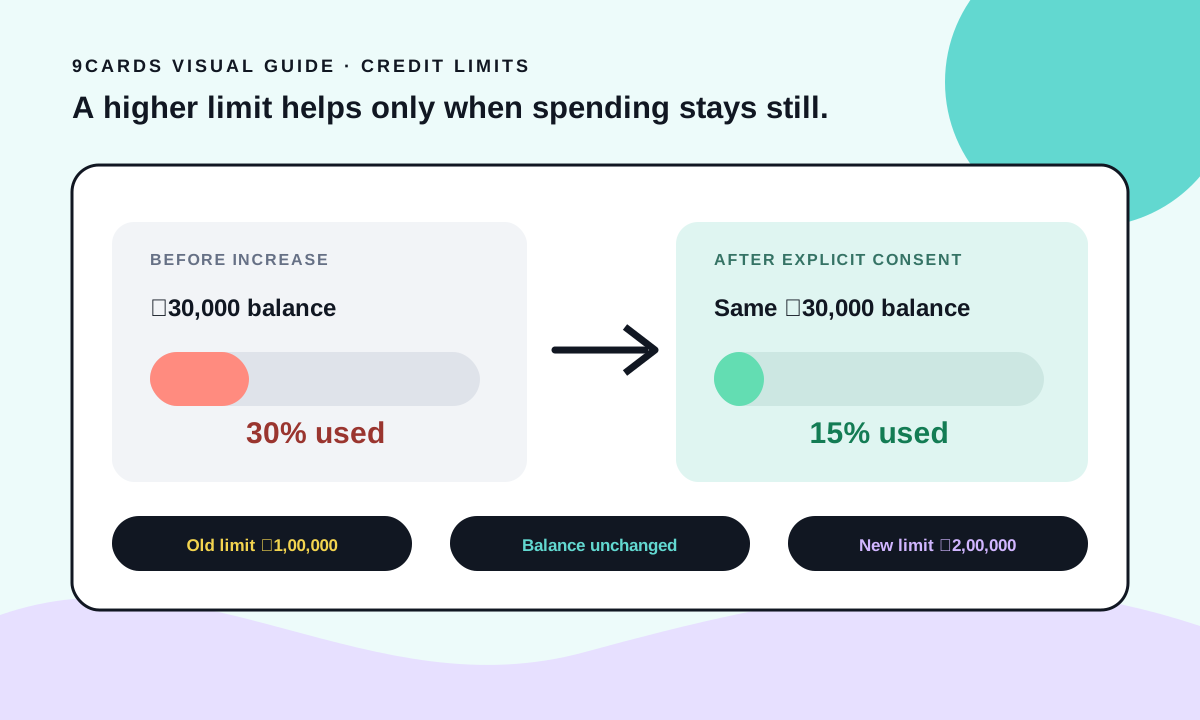
Utilisation is the reported card balance divided by the credit limit. Suppose the balance remains ₹30,000.
| Scenario | Balance | Limit | Utilisation |
|---|---|---|---|
| Before increase | ₹30,000 | ₹1,00,000 | 30% |
| After increase | ₹30,000 | ₹2,00,000 | 15% |
| After increase plus new ₹70,000 spending | ₹1,00,000 | ₹2,00,000 | 50% |
The first change lowers utilisation because borrowing did not rise. The second spending decision more than reverses the effect. Our credit-utilisation guide explains individual and total-limit calculations.
TransUnion CIBIL identifies payment history, utilisation, account age, enquiries and credit mix among the factors that can influence credit health. It does not publish a promise that doubling a card limit adds a fixed number of points. Treat any score movement as an outcome of the full file, not a guaranteed reward for accepting an offer.
Will requesting a limit increase affect CIBIL score?
It depends on how the issuer evaluates the request. A pre-approved offer may use existing account information, while a requested increase can involve updated income data and a credit-bureau enquiry. Ask whether the issuer will make a hard enquiry before submitting.
One enquiry does not have a universal point cost, and an issuer can decline despite a strong score. Internal policy may consider income, repayment history, account age, current exposure and obligations across products.
Check your CIBIL report afterwards for accuracy, not merely for a target score. The official CIBIL overview explains the score and report relationship.
Documents and eligibility
An issuer may ask salaried applicants for recent salary slips or bank information, and self-employed applicants for tax returns or statements. It may also use Account Aggregator consent to retrieve selected financial information.
Share documents only through the issuer's official secure channel. Verify the domain, do not email a card PIN, CVV or OTP, and read what data an Account Aggregator consent covers before approving it.
Common evaluation inputs include:
- consistent on-time payments;
- income and employment or business information;
- current limit and spending pattern;
- total debt and recent enquiries;
- internal account conduct;
- age of the card relationship.
These are possible underwriting inputs, not an entitlement formula.
Permanent versus temporary limit increase
A temporary increase can help with a planned booking, but the original limit returns on a fixed date. If the outstanding is still above that original limit when the offer expires, the account can have very little available credit or sit overlimit under the issuer's rules.
Example:
| Date | Limit | Balance | Position |
|---|---|---|---|
| Before temporary offer | ₹1,00,000 | ₹20,000 | ₹80,000 available |
| During temporary offer | ₹1,50,000 | ₹1,20,000 | ₹30,000 available |
| After expiry, before repayment | ₹1,00,000 | ₹1,20,000 | ₹20,000 above original limit |
Before accepting, ask the expiry date, whether the temporary amount supports all merchant categories and how much must be paid before reset. The overlimit guide explains why a temporary increase and overlimit consent are not the same.
When a higher limit is genuinely useful
A permanent increase can provide:
- a larger buffer against accidental high utilisation;
- capacity for necessary large purchases that will be repaid in full;
- less chance that subscriptions or settlement differences cause a decline;
- flexibility during travel without enabling overlimit use.
It is less useful when it encourages revolving debt or is accepted only to chase a score. The amount you can repay from cash flow remains the real personal spending limit.
If the purpose is a one-time purchase, compare paying the balance in advance, a temporary increase or delaying the purchase. Do not use a balance transfer to create room for fresh spending; our balance-transfer guide explains why moving debt is not reducing it.
How to request a credit limit increase safely
- Check the current limit, balance and available limit.
- Look for an authenticated pre-approved offer in the issuer app or website.
- If requesting manually, ask which income documents and bureau checks are needed.
- Submit only through a verified channel.
- Read whether the offer is permanent or temporary.
- Save the consent and new-limit confirmation.
- Keep spending unchanged until you see how the higher limit reports.
The SBI Card available-limit FAQ illustrates the difference between total and available limit and the issuer's request paths. Other banks can use different criteria and documents.
Why a request can be declined
A decline does not prove your CIBIL score is bad. The issuer can use internal exposure limits, income, recent account behaviour, portfolio policy or insufficient documentation. Avoid submitting repeated requests in a short period without understanding the reason, because additional bureau enquiries may not help.
Ask when the account can be reviewed again and what documents are accepted. In the meantime, reduce balances and maintain timely payments rather than trying to force an approval through an agent.
Frequently asked questions
Is a pre-approved limit increase free?
A limit increase normally is not a purchase or loan fee by itself, but check the offer for any product change, card upgrade or new annual-fee terms. Do not assume an accompanying upgrade is free.
Does a higher limit automatically improve CIBIL score?
No. It can lower utilisation if balances stay constant, but payment history, enquiries, account age and the rest of the report also matter.
Can the bank increase my limit without asking?
RBI directions require explicit consent for enhancement. An offer is not acceptance.
Should I accept every increase?
No. Accept when the additional buffer is useful and will not change spending discipline. Declining an offer is reasonable if you prefer a lower exposure.
Can I move limit between two cards from the same issuer?
Some issuers permit internal reallocation; others do not. Ask whether total exposure changes, whether either account closes and how reporting is affected.
Will a higher limit increase my cash limit too?
Not necessarily. Cash limit is a separate subset or control and can remain unchanged. Check the new statement before relying on it.
The practical answer
A credit limit increase is most valuable as unused headroom. Confirm explicit consent, understand whether the increase is permanent or temporary, ask about bureau enquiries and keep spending stable. The lower utilisation comes from the same balance over a larger limit—not from borrowing the new room.
Regulatory, issuer and CIBIL materials checked on 31 July 2026. Eligibility, documents, enquiry practices, limits and reporting can change.