A credit-card question can be one sentence and still require six different answers. “Why did I get charged interest?” might involve a cash withdrawal, a partial payment, a late-posted refund, an EMI conversion, a missed due date or the loss of the retail interest-free period. The useful answer changes with the transaction type and timeline.
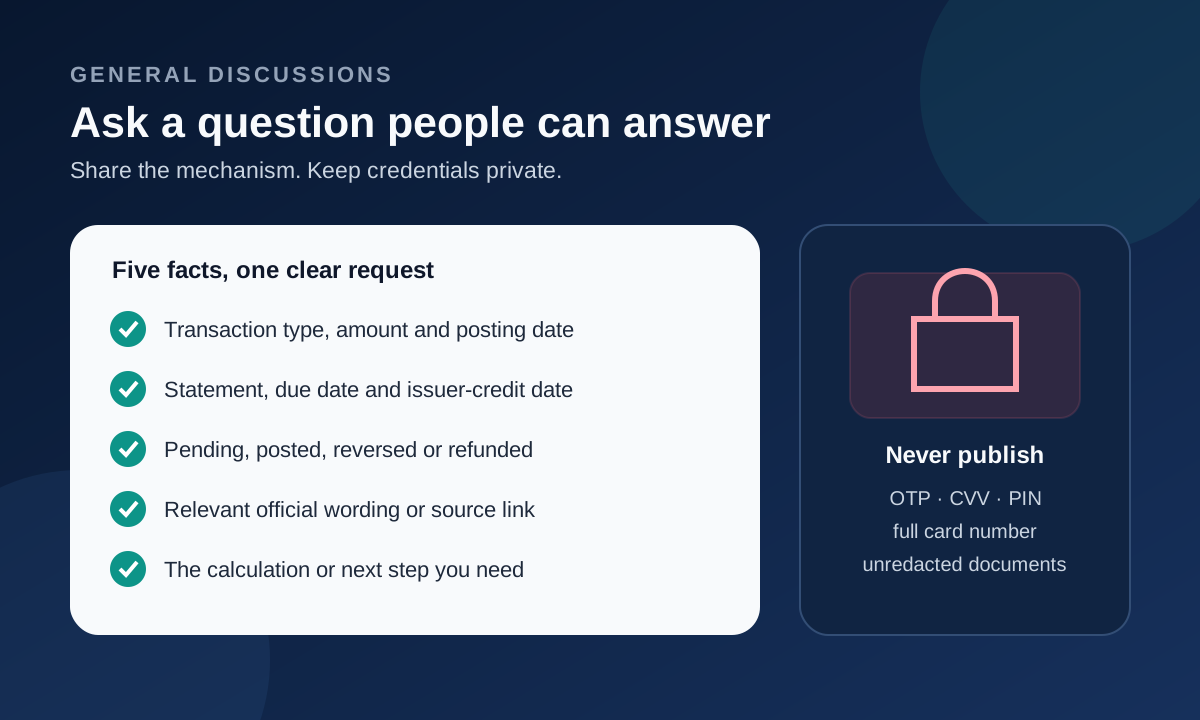
The fastest way to get help is not to share more personal data. It is to share the right account facts: dates, rounded amounts, whether entries are pending or posted, the statement due, the payment credit date and the exact clause you are trying to understand.
Never post a complete card number, CVV, PIN, OTP, password, login screenshot, PAN, Aadhaar number, unredacted statement or payment link. No legitimate forum answer needs those credentials.
The minimum useful question
A good question lets another reader reconstruct the mechanism without guessing your identity.
| Detail | Useful version | Why it changes the answer |
|---|---|---|
| Card context | Issuer type and card feature; last four digits omitted or masked | Terms differ across products and issuers |
| Event | “₹4,000 retail purchase posted on 8 July” | Transaction type decides fee and interest treatment |
| Statement | Cycle closed 12 July; total due ₹18,000 | Shows whether the event was billed |
| Payment | ₹14,000 credited 28 July; due date 30 July | Credit date and amount determine what remained |
| Current status | Pending, posted, reversed or refunded | These are different processing states |
| Relevant term | Paste a short paraphrase or official link | Prevents answers based on another card’s rules |
| Desired result | “How should I verify the interest base?” | One clear question produces a testable answer |
The RBI’s credit-card FAQ demonstrates why the sequence matters: its examples distinguish refunds before bill generation, after bill generation and after the cardholder has already paid. “I got a refund” is therefore incomplete without a posting date.
Use dates from records, not memory
Write a short timeline from the issuer app or statement:
- transaction date and posting date;
- statement generation date;
- payment due date;
- payment initiation and issuer-credit date;
- refund, reversal or fee posting date;
- date you first complained and the service-request number.
A merchant order date is not always the card posting date. A payment-app success message is not always the date the issuer credited the card account. A merchant promise is not a posted refund. Those distinctions explain many apparent contradictions.
For pending entries, use our authorisation and settlement explainer. For a refund near the due date, use the refund-after-bill checklist.
State what kind of balance you had
“Outstanding” can contain several buckets: retail purchases, cash, EMI, fees, tax, finance charges and a balance transfer. If you paid only part of the statement, say so. The issuer’s allocation order may have sent that payment somewhere other than the balance you intended to clear.
Our payment-allocation guide explains how to identify those buckets. Do not describe a cash advance as a normal purchase or an EMI instalment as the original purchase principal; their pricing can differ.
Ask recommendation questions with a spending pattern
“Which card is best?” has no neutral answer. A useful recommendation request includes:
- approximate monthly spend by category;
- online versus offline split;
- expected travel and lounge use;
- international spending in a year;
- willingness to pay an annual fee;
- existing cards and why they do not fit;
- whether rewards must be simple statement credit or can involve points;
- benefits you will not use.
Use ranges rather than exact income or account balances. Do not upload payslips. Eligibility is an issuer decision, and a stranger cannot guarantee approval from a profile summary.
The spend-led shortlisting framework turns those inputs into comparable annual value without naming a universal winner.
Ask fee questions with the calculation
For a fee or finance-charge question, include the line item and your calculation. Example:
The statement shows ₹720 finance charges plus tax. Total due was ₹20,000; ₹15,000 was credited before the due date. The issuer terms say interest applies to adjusted outstanding. Which dates and balances should I request to reproduce ₹720?
That is stronger than “bank charged too much” because it identifies what evidence is missing. The RBI FAQ explains that partial-payment interest and late charges should be based on adjusted outstanding after credited payments, refunds and reversals—not blindly on an amount already cleared.
Do not publish the full statement to prove the point. Redact names, addresses, account numbers, barcodes, QR codes and transaction references. A typed table is usually safer.
Ask reward questions after posting
A pending authorisation may change before it becomes a final transaction. Wait for posting, then provide:
- final merchant descriptor;
- transaction date and amount;
- reward cycle;
- category cap already used;
- exact exclusion or eligible-category wording;
- points expected and received.
If merchant classification matters, ask the issuer for the MCC rather than guessing from the shop name. The MCC explainer shows why the item purchased does not necessarily determine reward treatment.
Separate a correction request from a complaint
A correction request states what field is wrong and what it should be. A service complaint states what process failed. A credit report may need both:
| Problem | Evidence-led request |
|---|---|
| Wrong current balance | Identify account, report date, statement/payment evidence and correct balance |
| Unknown enquiry | Identify enquiry date and lender; ask lender to show application/consent |
| Closed card shown open | Attach closure confirmation and later report |
| Issuer did not answer | Provide original complaint date and ticket; request escalation |
| Disagreement with accurate history | Ask for explanation; do not label accurate data an error |
CIBIL’s official enquiry guidance provides a dispute path for an enquiry a consumer does not recognise. Its process still requires the reporting institution to verify the source data.
Frequently asked questions
Should I share the last four digits of my card?
Usually even that is unnecessary in a public post. Use “Card A” or a masked reference. Give account-specific identifiers only through the issuer’s authenticated channel.
Can someone calculate my exact interest from a screenshot?
Only if the screenshot contains all balances, dates and terms—and it may also expose sensitive data. Ask the issuer for the transaction-level calculation, then share a redacted typed summary.
Should I name the issuer?
Naming the issuer can help locate the applicable official terms, but avoid accusations you cannot evidence. Describe the event and link the current official document.
Can a forum predict whether my application will be approved?
No. Readers can discuss published eligibility and process, but underwriting uses issuer data and policy not visible to the forum.
What should I do with an unknown transaction?
Secure the card and contact the issuer immediately. Do not delay protective action while waiting for forum replies. Our unauthorised-transaction guide lists the evidence to preserve.
A reusable template
Copy this structure and remove any line that does not apply:
- What happened: one sentence.
- Transaction: type, rounded amount, transaction and posting dates.
- Statement: generation date, total due, minimum due and due date.
- Payment/refund: amount and issuer-credit date.
- Current status: pending, posted, reversed, refunded, closed or disputed.
- Official wording: short paraphrase plus issuer/RBI link.
- Already tried: complaint date and non-sensitive ticket status.
- Question: the single calculation, rule or next step you want explained.
A precise question protects your privacy and makes weak answers easy to spot. If an answer ignores the dates, invents a guaranteed approval, or asks for credentials, do not rely on it.
RBI and CIBIL materials checked on 31 July 2026. Source material was paraphrased; issuer procedures and terms can change.