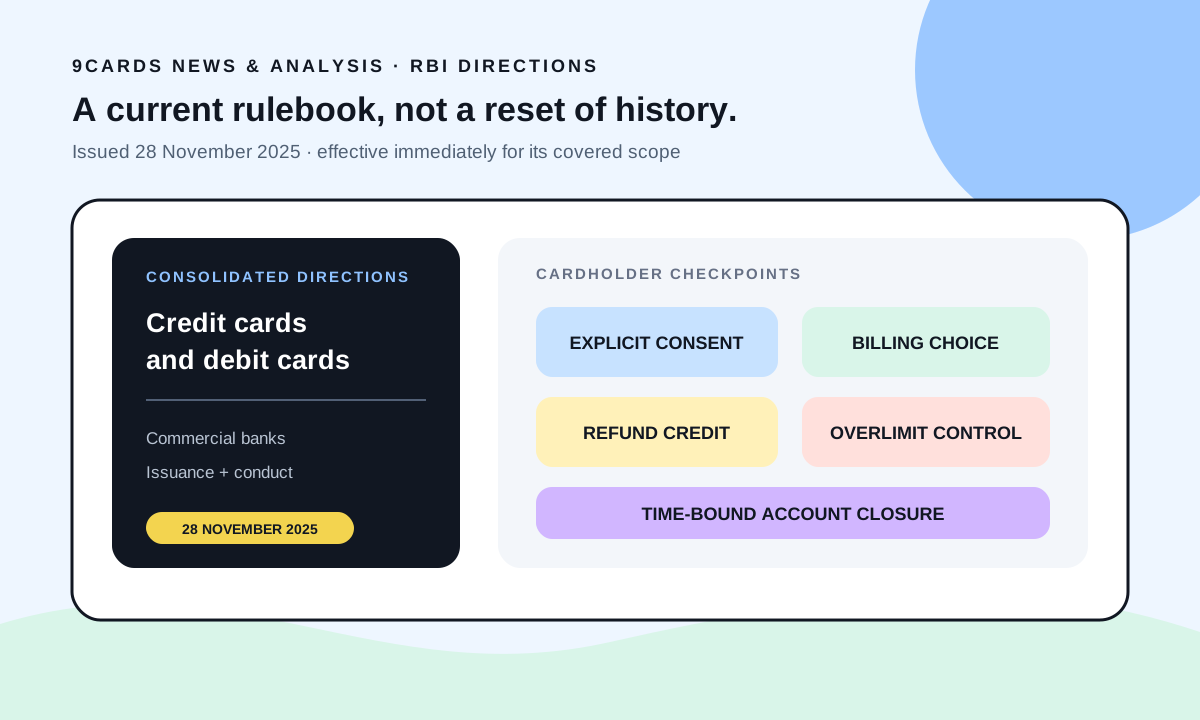
On 28 November 2025, the Reserve Bank of India issued the Reserve Bank of India (Commercial Banks – Credit Cards and Debit Cards: Issuance and Conduct) Directions, 2025 with immediate effect. For cardholders, the most important change was not a sudden invention of entirely new rights. It was RBI's move to an entity-specific, consolidated rulebook that carried forward core protections previously found in the 2022 Master Direction and later amendments.
That distinction matters. A headline saying “new 2025 rule” can make an older protection sound as if it began in November 2025. Consent before card issuance, controls on overlimit use, billing-cycle choice, refund adjustment and time-bound closure have a regulatory history. The 2025 Directions are the current place to check the consolidated position for covered commercial banks, not the birth date of every paragraph inside them.
What changed in November 2025
RBI's Commercial Banks card directions, 2025 are dated 28 November 2025 and took effect immediately. They sit within a broader regulatory consolidation exercise that issued rulebooks by regulated-entity type.
| November 2025 development | What it means | What it does not mean |
|---|---|---|
| New 2025 title and consolidated document | Covered commercial banks use the current entity-specific directions | Every paragraph first took effect in 2025 |
| Immediate commencement | The new rulebook replaced the prior instrument for its scope without a long transition | Existing complaints before that date lost their regulatory history |
| Repeal and saving provisions | Earlier directions were withdrawn while prior actions and rights were preserved as specified | Old conduct automatically became lawful or irrelevant |
| Separate regulatory tracks | Banks, RRBs, co-operative banks and NBFCs can have their own applicable directions | One commercial-bank document governs every possible issuer identically |
| Current source hierarchy | Readers should start with the live RBI direction and later amendments | Old screenshots and summaries remain reliable indefinitely |
The document itself runs through conduct of credit-card business, debit-card issuance, form factors, co-branding, general guidelines and miscellaneous provisions. It is a regulatory rulebook, not a card-comparison table.
The protections cardholders should still know
These are practical rules reflected in the current framework. Several pre-date the 2025 consolidation.
| Cardholder issue | Current practical protection | Earlier regulatory lineage |
|---|---|---|
| Unsolicited card | Prior and explicit consent is required; an unactivated unsolicited card should not become a chargeable account | Prominent in the 2022 direction and FAQ |
| Card not activated | Issuer must seek OTP-based consent after the prescribed inactivity window and close without cost if consent is not received | Carried forward protection |
| Overlimit facility | Prior explicit consent is required; cardholder should have control to enable or disable it | Clarified before 2025 |
| Billing-cycle date | Cardholder must receive an option to choose or modify the billing-cycle start/closing day at least once | 2024 amendment/FAQ position |
| Refund before due date | Eligible posted credits relating to the billed cycle can reduce what remains payable | Explained in RBI FAQ examples |
| Partial payment | Interest and late-related charges are applied to the adjusted outstanding under the rules, not blindly to an already repaid amount | Existing consumer-protection rule |
| Unpaid taxes and charges | Issuer must not capitalise unpaid taxes, levies and charges by charging further interest on them | Effective from the earlier framework |
| Card closure | Valid closure request must be completed within the regulatory timeline after dues are cleared | Existing rule carried forward |
| Co-branding data | Co-branding partner's access to card transaction data is restricted | Existing privacy/control protection |
The RBI's credit and debit card FAQ remains useful for understanding how the earlier framework operated, including concrete examples for refunds and billing cycles. For a complaint today, pair that explanation with the live 2025 direction and any later amendment.
Unsolicited cards and activation consent
A card issuer cannot treat silence as consent to issue and activate a credit card. RBI's FAQ explains that a customer receiving an unsolicited card should not activate it or provide activation consent. Where activation consent is not received under the prescribed process, the issuer must close the account without cost and inform the customer.
Activation is broader than making a purchase. Customer-initiated actions such as PIN generation or changing transaction controls can demonstrate intent to use the card. That is why the safest response to an unsolicited card is not to explore its app controls; report it in writing and ask for closure and confirmation.
If the account appears on a credit report despite never being requested, preserve the application record—or evidence that there was none—the delivery message, issuer complaint and closure response. Our card-closure guide explains how to verify that blocking a plastic card is not being mistaken for closing the credit account.
Billing-cycle choice is real but not unlimited switching
The RBI FAQ says a cardholder should be given an option to choose any date as the starting or closing day of the billing cycle at least once, with issuers able to offer channels such as helpline, email, IVR, internet banking or app.
That does not guarantee unlimited monthly changes. Ask the issuer which dates are operationally available, when the change takes effect and whether the transition creates a shorter or longer statement. Keep autopay and salary timing in mind.
Our billing-cycle explainer shows why the closing date affects the time between purchase and due date. A changed cycle does not preserve grace when the total due is left unpaid.
Refunds, reversals and the amount due
The current framework treats a posted credit differently from a merchant promise. RBI's FAQ uses scenarios to show the distinction:
- a refund received within the same billing cycle is adjusted before total due is calculated;
- a refund for a billed transaction received after bill generation but before payment can reduce the remaining due;
- a refund received after dues have already been paid can require consent for adjustment or transfer back under the applicable process.
This is why “refund approved” is not enough. The credit must reach the card account. Our refund-after-bill guide provides a worked calculation and a checklist for an approaching due date.
Pending authorisation releases are a different event from refunds. The pending-transaction explainer separates holds, reversals and posted credits.
Partial payment and the interest base
RBI's FAQ clarifies that when total due is not cleared, the interest-free period can be lost and interest may apply to the outstanding amount after payments, refunds and reversed transactions are credited. Late-payment-related charges likewise should not be calculated as though an adjusted portion remained unpaid when it did not.
This does not make partial payment cheap. Finance charges can still be substantial, and the issuer's allocation order decides which balance remains. Read our payment-allocation explainer before assuming a payment cleared cash or a promotional balance first.
The rule against capitalising unpaid taxes, levies and charges is another important distinction. It stops one layer of charges from itself becoming an interest-bearing principal merely because it remains unpaid. It does not remove the original fee or tax where validly charged.
Overlimit requires an affirmative choice
An issuer cannot simply allow spending beyond the sanctioned limit and then charge an overlimit fee without prior explicit consent. The cardholder should have a control to enable or disable the facility.
Interest, taxes and fees should not be used to manufacture an overlimit event for the purpose of levying an overlimit charge. Our overlimit-facility guide explains the difference between exceeding the limit through a purchase and seeing the balance cross it because issuer charges posted later.
If a transaction exceeded the limit, ask for the timestamp of your consent, the transaction that crossed the limit and the fee calculation. A generic clause buried in a welcome kit is not the same evidence as the explicit control contemplated by the rule.
Closure: blocked is not closed
Blocking stops transactions. Closure ends the account relationship after valid dues are resolved. RBI's FAQ states that the closure timeline excludes the time a cardholder takes to clear outstanding dues, but the issuer should disclose those dues rather than waiting for another billing cycle without explanation.
After paying the closure amount, obtain a service-request number and written zero-balance/closure confirmation. Then check a later credit report. A replacement card, expired plastic or disabled transaction switch does not prove the account was closed.
The regulatory compensation for delayed closure should not be self-calculated and netted off against dues. Raise the complaint, document the delay and use the issuer's grievance process.
What the 2025 Directions do not guarantee
The consolidated rules do not guarantee:
- approval for every card application;
- one interest rate, reward rate or credit limit across issuers;
- continued benefits after programme terms lawfully change;
- a particular card network on every product;
- instant refunds before they reach the issuer;
- automatic deletion of accurate credit history;
- protection from interest when total due is not paid.
Card-network choice is governed by a separate RBI circular and has scope and exemptions. Our network-choice analysis explains why it is not an unrestricted right to port any card at any time.
How to use the rules in a complaint
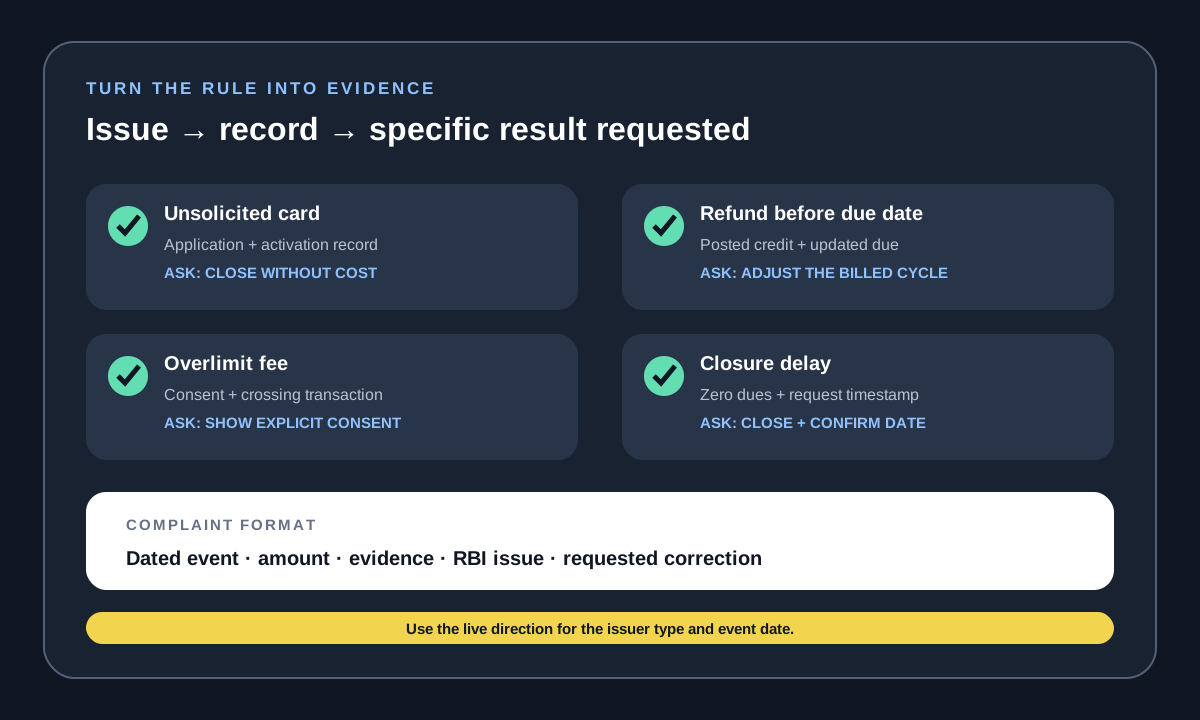
A concise complaint is stronger than a broad allegation. Include:
- account/card last four digits, without sharing full credentials;
- dated event and amount;
- the specific result requested;
- screenshot, statement or service-request evidence;
- the relevant RBI direction or FAQ issue;
- a reasonable deadline for written response.
First use the issuer's grievance channel. If the issuer rejects the complaint, gives an unsatisfactory response or does not respond within the RBI complaint framework's waiting period, the FAQ points to the RBI Complaint Management System and the Integrated Ombudsman route. Eligibility and maintainability rules still apply.
Frequently asked questions
Did all RBI credit-card rules start on 28 November 2025?
No. The 2025 Directions consolidated and reorganised a framework containing protections from the 2022 direction and later amendments. Use the date relevant to the conduct in question.
Do the commercial-bank directions cover every card issuer?
Do not assume so. RBI issued entity-specific directions. Identify whether the issuer is a commercial bank, NBFC or another regulated category and use the applicable current document.
Can I change my statement date every month?
The regulatory FAQ provides a choice at least once. Further changes depend on the issuer's process and operational options.
Does any refund automatically count as bill payment?
No. Timing, posting and the billing cycle matter. Verify that the credit reached the account and check the issuer's updated total and minimum due.
Can an issuer enable overlimit by default?
The framework requires prior explicit consent and a control to enable or disable the facility. Challenge a fee if the issuer cannot show the relevant consent and transaction.
Are reward devaluations prohibited by these directions?
The directions regulate conduct and disclosures, but they do not freeze every rewards programme forever. Notice, contract and fairness questions depend on the facts and applicable terms.
The practical answer
The 2025 Directions matter because they are a current consolidated rulebook for covered commercial banks. Their date should not be used to erase the lineage of protections that already existed.
For a real problem, identify the issuer type, use the live RBI document, cite the specific issue—consent, billing, refund, overlimit, interest or closure—and attach the account evidence. The rule is most useful when it is connected to a dated transaction rather than reduced to a “new RBI rules” headline.
RBI materials checked on 31 July 2026. RBI directions can be amended; use the live document and the rule applicable to the issuer type and event date.